
Solar Proposal Software vs. Done-For-You Engineering Proposals: What Wins More Business in 2026?

Struggling to Close Deals? Your Solar Proposal Process Could Be the Problem
Every solar installer in the US knows this pain. You run a great site visit, the homeowner seems interested — but the proposal takes two or three days to land in their inbox. By then, a competitor has already sent theirs. Just like that, the deal is gone. Solar proposal software has been the go-to fix for this bottleneck for years. However, done-for-you engineering proposals are gaining serious ground among EPCs and high-volume installers who need accurate, permit-ready deliverables fast. Both approaches solve real problems, yet in 2026, only one is consistently winning business at scale. This blog breaks down exactly which one — and why.
What Solar Proposal Software Offers Solar Installers and EPCs
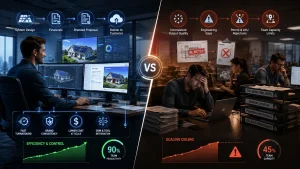
Solar proposal software gives your in-house team the tools to generate proposals without outside help. Platforms like Aurora Solar, Scanifly, and similar tools let reps build system designs, financial projections, and branded decks quickly. Most run on monthly subscriptions. Therefore, your team owns the full design-to-delivery workflow.
The Real Advantage — and the Real Ceiling
The primary advantage is control. When trained properly, your team turns proposals around fast and manages its own branding. That said, output quality depends entirely on who operates the platform. A newer rep using solar proposal software will often deliver results far less accurate than what a licensed engineer produces.
Here are the core benefits of solar proposal software:
- Quick turnaround with a well-trained sales team
- Full brand consistency across every customer-facing proposal
- Lower per-proposal cost at high volume
- Native integration with solar CRM tools and project dashboards
In addition, software scales reasonably well for smaller teams. However, it comes with real limits — ongoing training, licensing fees, and active management. Moreover, software-only proposals often lack the engineering depth that AHJs and utility companies actually expect. And when project volume spikes suddenly, your in-house team hits its ceiling fast — right when you can least afford the slowdown.
What Done-For-You Solar Engineering Proposals Actually Deliver
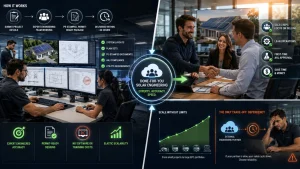
Done-for-you solar engineering proposals take the entire design burden off your team. Submit your project details, and an expert engineering team handles the system layout, plan sets, and PE-stamped documents. In turn, you receive a fully engineered, permit-ready package — typically within 24 hours.
Why This Model Fits High-Volume Installers and EPCs
This approach is a natural fit for growing EPCs and high-volume solar installers. Instead of maintaining an in-house design department, you outsource to licensed specialists who do this work every single day. Consequently, your sales reps stay focused on selling. Your operations stay lean. Additionally, your proposals consistently clear AHJ review on the first submission — which alone saves enormous time and money.
Key advantages of done-for-you engineering proposals:
- Expert-engineered accuracy on every project
- Permit-ready designs built for first-time AHJ approval
- No software licensing, training costs, or in-house design staff
- Elastic scalability that grows with your volume
The trade-off, however, is external dependency. If your engineering partner runs slow, your sales cycle stretches. For this reason, choosing a reliable done-for-you provider matters just as much as the service model itself.
Solar Proposal Software vs. Done-For-You Engineering: Which Wins More Deals?
The honest answer depends on where your business stands today.
Small and Mid-Size Installers vs. High-Volume EPCs
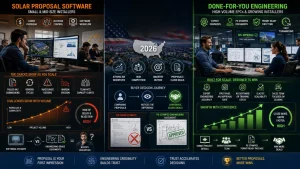
For smaller installers managing 10 to 30 projects monthly, solar proposal software is a reasonable starting point. It keeps overhead controlled and puts your team in the driver’s seat. However, as volume grows, the cracks start showing. Failed AHJ submissions, rework cycles, and inaccurate designs eat directly into margins.
For growing EPCs and high-volume solar installers, on the other hand, done-for-you engineering proposals deliver a clear competitive edge. Rather than just sending a polished estimate, you’re delivering a fully engineered, compliant package. That builds customer confidence from the first interaction. Furthermore, confidence closes deals faster than any sales script can.
What 2026 Solar Market Conditions Mean for Your Proposal Strategy
The US solar market in 2026 is more competitive than it’s ever been. IRA incentives continue driving strong residential and commercial demand. Additionally, installers across every state are chasing the same customers. In this environment, your proposal is often the first real impression of your company’s quality. Indeed, top-performing installers now treat the proposal process as a direct closing tool — not just an administrative step. Ultimately, buyers in 2026 are sharper than ever. A commercial decision-maker comparing proposals will quickly notice the gap between a software estimate and a PE-stamped engineering document. Engineering credibility, therefore, converts.
The Hybrid Approach: Solar CRM Software Plus Done-For-You Engineering

Here’s what the smartest solar installers and EPCs are doing right now. They’re not choosing one approach over the other. Instead, they’re pairing a solar CRM platform with done-for-you engineering services to eliminate every bottleneck in the sales pipeline.
How the Workflow Actually Runs
The solar CRM manages lead tracking, customer communication, project status updates, and proposal delivery. Meanwhile, the engineering team handles system design, plan sets, and permit documentation. Both work in complete sync.
The workflow is straightforward. A sales rep logs a new lead and submits project details through the CRM. Subsequently, the engineering team returns fully engineered solar engineering proposals within 24 hours. The proposal lands in the customer’s inbox — PE-stamped, permit-ready, and professionally branded. Delays are eliminated. Rework drops off entirely. Guesswork exits the process for good.
As a result, close rates improve, AHJ submissions pass on the first attempt, and back-office overhead shrinks — all simultaneously.
How EnergyScape Renewables and Sunscape Solar Power This Model
EnergyScape Renewables is built for exactly this workflow. Their team delivers precision-engineered solar sales proposals in as little as 15 minutes. Moreover, full PE stamping is completed within 24 hours, covering all 50 states. Their 99% AHJ approval rate reflects the engineering accuracy built into every single deliverable. Whether you’re running 20 projects a month or scaling toward 200, EnergyScape handles done-for-you solar engineering proposals at any volume — without sacrificing turnaround speed.
On the software side, Sunscape Solar serves as your solar operating system. It tracks your full project pipeline, automates customer follow-ups, monitors permitting milestones, and integrates directly with EnergyScape’s engineering workflow. Together, they cover both sides of the proposal equation — software efficiency on one end and engineering precision on the other.
If your current proposal process is creating delays or costing you deals, EnergyScape Renewables has the infrastructure to fix it. Visit Sunscape Solar to explore how the CRM layer connects your entire sales and engineering workflow from first contact to PTO.
The Bottom Line for Solar Installers and EPCs
Solar proposal software is a practical tool. It works well for teams with the training and capacity to manage proposals internally. Still, for solar installers and EPCs focused on winning more business in 2026, done-for-you engineering proposals deliver what software alone simply cannot — PE-stamped accuracy, first-time AHJ compliance, and the professional credibility that earns customer trust quickly.
Overall, speed grabs attention in today’s competitive US solar market. Engineering depth, however, wins the contract.
sjayakanth@energyscaperenewables.com