
NFPA 855 Residential Battery Setbacks: 2026 Installer Guide
The 2026 Battery Code Shift Every Solar Installer Needs to Know: NFPA 855 & NEC 706 Setbacks Explained
NFPA 855 residential battery, If you’re installing solar-plus-storage systems in 2026, there’s a good chance you’ve hit a wall with an Authority Having Jurisdiction (AHJ) over battery placement. Maybe it was the 3-foot spacing requirement between units. Or the garage capacity limits. Or the new Hazard Mitigation Analysis (HMA) that suddenly applies to nearly every residential battery job.
The 2026 edition of NFPA 855 rewrote the rulebook for battery energy storage systems, and it’s catching installers off guard. Here’s what changed, what it means for your workflow, and how to navigate residential battery compliance without permit delays or costly redesigns.
What Changed in the 2026 NFPA 855 Update
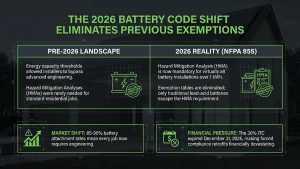
The National Fire Protection Association released the 2026 edition in September 2025, and the most significant shift is this: Hazard Mitigation Analysis (HMA) is now mandatory for virtually all battery installations over 1 kWh.
In previous editions, you could skip the HMA if your project stayed under certain energy thresholds. Those tables are gone. Now, unless you’re installing traditional lead-acid batteries, you need an HMA. For installers working with 85-90% battery attachment rates, this means every job needs engineering documentation that wasn’t required before.
Residential Battery Setback Rules You Need to Know
NFPA 855 Chapter 15 covers residential installations, and the spacing requirements are non-negotiable:
Individual Unit Capacity
- Maximum 20 kWh per ESS unit
- Multiple units allowed if properly spaced
Location-Specific Capacity Limits
- Garage installations: 80 kWh total
- Outdoor wall-mounted: 80 kWh total
- Utility closets/storage: 40 kWh total
- Inside the home: 40 kWh total
Required Spacing
- 3 feet minimum between individual ESS units
- 3 feet clearance from doors and windows (outdoor installations)
- Closer spacing allowed only with UL 9540A fire test documentation
Prohibited Locations
- Bedrooms, living areas, habitable spaces
Some AHJs interpret these limits differently. California’s fire marshal has indicated you might install 80 kWh in the garage, 80 kWh outside, and 40 kWh inside the same home—totaling 200 kWh. But that’s not universal. Always verify with your local jurisdiction before promising capacity to customers.
NEC 706: The Electrical Side of Battery Compliance
While NFPA 855 handles fire safety and placement, NEC Article 706 governs electrical installation requirements for Energy Storage Systems.
Key NEC 706 Requirements
Scope: Applies to all permanently installed ESS with capacity greater than 1 kWh (3.6 MJ).
Disconnecting Means: Every ESS needs a readily accessible disconnect that isolates the battery from all circuits. This disconnect must be clearly labeled, located within sight of the ESS, and accessible to building occupants.
Ventilation: Modern lithium-ion batteries like LiFePO4 don’t need the same ventilation as older flooded lead-acid batteries. However, thermal management is critical—follow manufacturer specifications exactly.
Labeling: NEC 706 requires specific signage identifying ESS location, battery chemistry, emergency shutdown procedures, and voltage ratings.
The Permit Rejection Patterns We’re Seeing
Here are the most common reasons residential battery permits get kicked back:
- Missing HMA documentation – The #1 issue in 2026
- Inadequate clearance documentation – AHJs want proof of 3-foot spacing
- No UL 9540 listing – Equipment not properly certified
- Incorrect capacity calculations – Not accounting for aggregate energy limits
- Missing NEC 706 disconnect labels on electrical drawings
- Ventilation plans not addressed for indoor installations
- Smoke alarm coordination for NFPA 855 compliance
Jurisdictions that adopted the 2026 codes are scrutinizing battery installations far more closely than they did 18 months ago.
Why This Matters More in 2026
Three factors are making battery compliance more urgent:
High Attachment Rates: With 85-90% of residential solar projects now including storage, the volume has exploded. More projects mean more AHJ scrutiny and more compliance opportunities.
Federal Tax Credit Expiration: The 30% Investment Tax Credit expired December 31, 2025. Installers who rushed projects in late 2025 are discovering compliance issues forcing expensive retrofits.
Insurance Requirements: More insurers and lenders require proof of NFPA 855 compliance before approving solar-plus-storage projects. No compliance = no financing for your customer.
How Solar Installers Are Adapting
The installers getting projects approved quickly share these strategies:
Engage AHJs Early: Before promising a customer 100 kWh of storage, confirm what your jurisdiction allows. A 15-minute call with the fire marshal can save weeks of redesign.
Use PE-Stamped Engineering: HMAs require professional engineering sign-off. Working with licensed engineers who specialize in battery systems ensures your documentation meets AHJ expectations the first time.
Specify UL 9540A-Tested Equipment: Batteries with UL 9540A fire propagation testing data give you more flexibility on spacing and placement.
Build Compliance Into Sales: Educate customers upfront about placement restrictions and capacity limits. Setting proper expectations prevents disappointment when permits come back.
Track Code Adoption: Not every AHJ has adopted the 2026 codes yet. Some are still on 2019 or 2023 editions. Know which version applies to each project area.
The Engineering Speed Advantage
When you’re managing multiple battery projects across different jurisdictions, speed matters. But so does accuracy. A plan set that includes proper HMA documentation, setback calculations, and NEC 706 labeling gets approved. A rush job without those elements gets rejected.
That’s why installers are partnering with specialized solar engineering firms that can deliver PE-stamped battery designs in 24 hours. The overnight turnaround gives you a competitive edge while ensuring compliance.
NFPA 855 Residential Battery: Your Battery Compliance Checklist
Before submitting your next residential battery permit, verify:
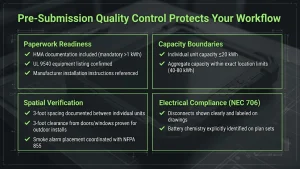
✓ HMA documentation included (unless using traditional lead-acid)
✓ Unit capacity ≤20 kWh per ESS unit
✓ Aggregate capacity within location limits (40-80 kWh depending on placement)
✓ 3-foot spacing between units documented
✓ 3-foot clearance from doors/windows (outdoor installs)
✓ UL 9540 equipment listing confirmed
✓ NEC 706 disconnect shown and labeled on electrical drawings
✓ Battery chemistry identified on plans
✓ Smoke alarm placement addressed (NFPA 855)
✓ Manufacturer installation instructions referenced
Get these right, and you’ll spend less time chasing permit corrections and more time installing systems.
Get Battery-Ready Engineering in 24 Hours
The 2026 battery code changes don’t have to slow you down. When your projects need PE-stamped engineering with proper HMA documentation and setback calculations, speed and accuracy aren’t optional—they’re essential.
Energyscape Renewables specializes in solar-plus-storage engineering for installers managing high-volume battery projects. With nationwide licensing and a 99% AHJ approval rate, their team delivers compliant plan sets overnight—even when you’re dealing with complex systems and multiple units.
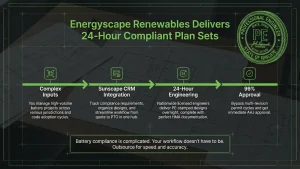
Whether you need design services, permitting support, or interconnection documentation, Sunscape CRM keeps your battery projects organized across every jurisdiction. Track compliance requirements, manage PE-stamped drawings, and streamline your workflow from quote to PTO.
Start Your Next Battery Project →
Battery compliance is complicated. Your workflow doesn’t have to be.
Frequently Asked Questions (FAQ): NFPA 855 Residential Battery
How far must batteries be from windows?
According to NFPA 855 residential battery setbacks, outdoor ESS units must maintain a minimum 3-foot clearance from all doors and windows.
What is the maximum battery capacity for a residential garage?
The 2026 code limits garage installations to an aggregate total of 80 kWh, with no single unit exceeding 20 kWh.
Do I really need an HMA for every job?
Yes. In the 2026 edition, the energy thresholds that previously allowed you to skip the Hazard Mitigation Analysis have been removed for most chemistries.
sjayakanth@energyscaperenewables.com