
Florida HVHZ Solar Permitting: Miami-Dade & Broward Guide 2026
Florida HVHZ Solar Permitting in 2026: The Miami-Dade and Broward Complete Guide for Solar Installers.
Florida HVHZ solar permitting is the most demanding permitting environment in the United States. If you’re a solar installer or EPC expanding into Miami-Dade or Broward County in 2026, understanding the High-Velocity Hurricane Zone (HVHZ) requirements isn’t optional — it’s the difference between closing projects on time and watching them stall for weeks.
This guide covers everything you need: NOA certification, PE stamp requirements, the key differences between Miami-Dade and Broward, and how to build a backend process that keeps your pipeline moving in South Florida’s competitive solar market.
What Is Florida HVHZ Solar Permitting, and Why Does It Matter for Solar Installers?
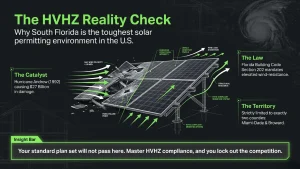
The High-Velocity Hurricane Zone (HVHZ) is a Florida Building Code designation that covers exactly two counties: Miami-Dade and Broward. These counties enforce hurricane-resistant construction standards that go significantly beyond the rest of Florida — and far beyond most other states.
The HVHZ framework was created in response to Hurricane Andrew (1992), which caused over $27 billion in damage across South Florida. Since 2001, the Florida Building Code Association has maintained elevated wind-resistance requirements specifically for this zone.
For solar installers, the HVHZ means one thing above all else: your standard plan set won’t pass here. Every component, attachment method, and structural calculation must meet a higher engineering bar. However, the good news is that installers who master HVHZ compliance gain a real market advantage. Because the bar is high, fewer competitors can operate here effectively.
NOA vs. Florida Product Approval: What You Need to Know About Florida HVHZ Solar Permitting
Before submitting any permit in Miami-Dade or Broward, every solar component in your system must carry one of these two certifications:
Miami-Dade Notice of Acceptance (NOA) — a local product certification from Miami-Dade County’s Product Control Division. It confirms a specific product has passed HVHZ wind tunnel testing. Importantly, an NOA covers individual products — your panel model, racking system, clamps, flashing, and lag bolts all require separate certifications.

Florida Product Approval with HVHZ Certification — a statewide credential accepted across all 67 Florida counties, including Miami-Dade and Broward. The testing standards are identical to an NOA. Therefore, either credential works — you only need one, not both.
What you cannot use is a standard Florida Product Approval without the HVHZ designation. “Approved for use in Florida” is not the same as “Approved for use in the HVHZ.” Permit examiners check this specifically, and a missing HVHZ certification on any component triggers immediate rejection.
Pro tip: Always verify active NOA and HVHZ certification status through the Florida Building Code Information System at floridabuilding.org before you spec equipment. Certifications expire. A component valid last quarter may not be valid today.
PE Stamping in HVHZ: Why Your Plan Set Must Be Airtight
Florida requires PE stamps on solar permits statewide. However, HVHZ projects go deeper. A Florida-licensed Professional Engineer must sign off on structural calculations that specifically address HVHZ wind load conditions using ASCE 7-16 methodology.
Those calculations must account for dead load, live load, and wind uplift — all based on the specific roof’s shape, pitch, height, and exposure category. Furthermore, your plan set must include NOA documentation for every component, cross-referenced and accurately matched to your equipment spec sheets.
Here’s where most out-of-area installers get burned: a single mismatch between your equipment spec sheet and your plan set drawing is enough to trigger a correction notice. In Miami-Dade, that correction adds weeks to a permit that was already running 10–15 business days under standard review.
Consequently, working with an engineering partner who regularly handles HVHZ plan sets — not just general Florida solar — makes a measurable difference in your first-submission approval rate. For context, Miami-Dade’s permit turnaround with complete, NOA-compliant documentation typically runs 2–4 weeks. Without it, timelines stretch to months.
For complete Florida PE stamping and plan set services across all 67 counties, EnergyScape Renewables delivers HVHZ-compliant packages with 24-hour PE stamp turnaround.
Miami-Dade vs. Broward: Side-by-Side Comparison
Both counties sit within the HVHZ, but the permitting experience is different in practice.
| Factor | Miami-Dade County | Broward County |
|---|---|---|
| Wind speed requirement | 185 mph sustained / 200+ mph gusts | 170–180 mph (Risk Category II) |
| NOA requirement | Required for every component | Required (HVHZ standard) |
| Portal | iBuild electronic permitting system | Broward e-permitting portal |
| Standard review timeline | 10–15 business days | Faster; same-day possible for clean submittals |
| Residential permit fee | $200–$500 based on system size | $150–$400 |
| Municipality complexity | 36 separate building departments | More centralized |
| Tile roof prevalence | Extremely high | Very high |
The key takeaway: Miami-Dade is harder. Its 36 municipalities each maintain separate building departments, so AHJ requirements vary even within the county. Broward is still demanding — but its more streamlined system allows faster approvals when your documentation is clean.
Additionally, if you’re working near the county line, always verify your jurisdiction before building your permit package. An address in Miramar may fall under Broward while a nearby address follows Miami-Dade rules entirely.
Tile Roofs: South Florida’s Hidden Permit Challenge
Drive through any neighborhood in Miami-Dade or Broward and you’ll see one thing on nearly every roof: tile. Concrete tile, clay tile, and barrel tile dominate the South Florida landscape, because they handle heat, rain, and wind better than asphalt shingles in a tropical climate.
For solar installers, this matters because tile roof attachment in HVHZ is a separate discipline. Lag bolts must penetrate into structural members — not just sheathing. Rail spacing and reinforcement requirements are tighter than on asphalt. Additionally, many tile installations require comp-out methods or partial tile removal and replacement.
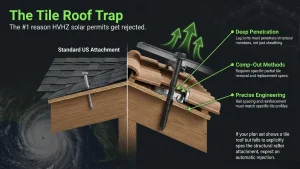
If your plan set shows a tile roof but doesn’t fully spec the attachment method for that roof type, expect a correction. Moreover, incomplete tile attachment documentation is one of the most common reasons Miami-Dade solar permits get kicked back. Solve this before submission, not after.
How to Build an HVHZ Permitting Process That Actually Works
Installers who scale successfully in South Florida operate with a few non-negotiables in place:
First, pre-qualify your equipment inventory. Build a list of panels, racking, clamps, and attachments that carry active NOA or HVHZ-certified Florida Product Approvals. Stick to that list on every South Florida deal. Substituting components mid-project because something is out of stock creates permit problems.
Second, use a site survey process designed for HVHZ. Roof age, tile type, rafter spacing, and structural attachment points all need accurate field capture. Because a plan set built on incomplete site data will fail — not due to engineering error, but due to missing information.
Third, partner with a Florida PE who works HVHZ regularly. A general engineering firm unfamiliar with HVHZ will produce plan sets that miss the mark. You need someone who knows the iBuild portal, knows Miami-Dade’s correction triggers, and delivers compliant packages the first time.
Fourth, manage the entire workflow in one place. HVHZ projects have more documentation requirements, longer timelines, and more team handoffs than standard installs. Running that coordination in email threads and spreadsheets creates the exact gaps that delay your permits.
Your South Florida Solar Backend: Engineering + CRM That Perform Together
South Florida is a high-reward market. But it demands a backend that can handle the engineering complexity and project coordination that HVHZ installs require.
EnergyScape Renewables handles the engineering side. Their Florida-licensed PEs deliver HVHZ-compliant plan sets with 24-hour turnaround — including ASCE 7-16 structural calculations, NOA documentation packages, Arc-Calcs, Load Calcs, and complete electrical single-line diagrams. With a 99% AHJ approval rate and coverage across all 67 Florida counties, EnergyScape is built specifically for high-volume, high-complexity solar markets like Miami-Dade and Broward.
Sunscape Solar manages the project coordination layer. As a CRM and project management platform purpose-built for US solar installers and EPCs, Sunscape connects your sales team, engineering partners, permitting coordinators, and field crews in one workflow. For HVHZ projects — where documentation accuracy and team handoffs directly affect permit outcomes — that visibility is essential.
Together, these two platforms give you the engineering muscle and operational infrastructure to win consistently in South Florida’s most demanding solar market.
Ready to move faster on your next HVHZ project? → Get a quote from EnergyScape Renewables for HVHZ-compliant PE stamping and plan sets. → Start with Sunscape Solar to manage your full project pipeline from permit to PTO.
Frequently Asked Questions About Florida HVHZ Solar Permitting
What does HVHZ mean in Florida solar permitting?
HVHZ stands for High-Velocity Hurricane Zone. Under Section 202 of the Florida Building Code, the HVHZ consists of Miami-Dade and Broward Counties only. Solar installations in these counties must meet stricter wind load and product certification requirements than anywhere else in Florida.
Do I need a PE stamp for solar permits in Miami-Dade?
Yes. Every solar installation in Miami-Dade requires structural calculations stamped by a Florida-licensed PE, specifically addressing HVHZ wind loads using ASCE 7-16 methodology. This applies to residential and commercial projects without exception.
What is a Miami-Dade NOA for solar?
A Miami-Dade Notice of Acceptance (NOA) is a product-level certification from Miami-Dade’s Product Control Division. It confirms a solar component — panel, racking, or attachment hardware — has passed HVHZ wind resistance testing. Every component in your system must carry a current NOA or equivalent Florida Product Approval with HVHZ Certification.
How long does Miami-Dade solar permitting take in 2026?
Standard review runs 10–15 business days. With complete NOA documentation and a clean plan set, most installers receive approval in 2–4 weeks. Incomplete packages or component mismatches can push timelines to months.
Is Broward County easier to permit in than Miami-Dade?
Generally, yes. Broward uses a more centralized permitting portal and offers same-day approvals for clean residential submittals. However, Broward still falls within the HVHZ and requires the same wind-resistance documentation and NOA-certified components.
sjayakanth@energyscaperenewables.com