
Back to Blog Page
Solar Permitting Outsourcing: In-House vs. Third-Party in 2026
Solar Permitting Outsourcing vs. In-House: The Real Cost-Per-Project Math
Solar permitting outsourcing is one of the most overlooked margin levers available to U.S. solar installers and EPCs today. Most companies assume keeping permitting in-house saves money. The real math tells a very different story — and once you run the numbers, the decision becomes hard to argue against.
Your in-house permitting team might be costing you $300–$500 more per project than you think. The problem is you’d never spot it on a single line item. Hidden costs stack quietly: idle engineering hours during slow seasons, resubmission rework from AHJ non-compliance, multi-state PE licensing gaps, and a throughput ceiling that limits how fast your pipeline can actually grow.
This article breaks down the full cost comparison. Because for most growing solar businesses, outsourcing permitting isn’t a budget cut — it’s a margin multiplier.
What Does In-House Solar Permitting Actually Cost?
The sticker price of an in-house PE looks like a salary. However, the fully loaded cost looks much heavier.
A mid-level solar PE in the U.S. earns between $85,000 and $120,000 per year. Add 25–35% for benefits, payroll taxes, and overhead, and that engineer costs your business $106,000–$162,000 annually. Therefore, if your team closes 200 residential projects per year, you’re spending $530–$810 per project in engineering labor alone — before a single resubmission.
Beyond that, solar installation is seasonal. Your pipeline in January looks nothing like your pipeline in June. Consequently, your salaried PE keeps drawing a paycheck year-round regardless of project volume. During slow months, you pay for availability rather than output. In contrast, with solar permitting outsourcing you pay per project. Zero projects means zero cost.
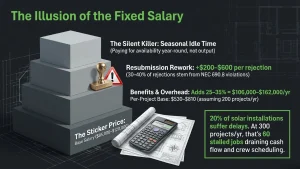
Resubmissions add another layer. NEC 690.8 violations account for roughly 30–40% of solar permit rejections nationwide. Each resubmission triggers AHJ fees, internal rework labor, and project delays — typically costing $200–$600 per corrected submission, plus the downstream cash flow drag of a stalled job.
Finally, PE licensing is state-specific. An engineer licensed in Texas cannot stamp plans in Florida or California. So as soon as your business expands geographically, your in-house resource hits a hard ceiling. You either hire additional state-licensed engineers or you turn down work.
Key stat: Project delays impact 20% of solar installations. For a company running 300 projects annually, that’s 60 stalled jobs — each carrying cash flow drag, customer dissatisfaction, and crew scheduling waste.
When Does Outsourcing Solar Permitting Make Financial Sense?
Outsourcing makes the most financial sense in five clear scenarios — and if your business is growing, you’ll hit at least two of them this year.
Multi-state expansion. There are over 20,000 permitting jurisdictions across the United States. No single in-house team maintains AHJ-specific knowledge at that scale. Moreover, every new state means new PE licensing fees, new relationships, and new compliance knowledge. Third-party engineering partners like EnergyScape Renewables cover all 50 states with no additional overhead on your end.
Volume spikes. A large commercial project or a strong referral run can triple your permit queue overnight. In-house teams have a fixed throughput ceiling. Outsourced partners scale with your pipeline — instantly, without a hiring lag.
NEC 2026 compliance pressure. Enforcement of updated PE stamp requirements has tightened significantly in 2025–2026. In-house teams scrambling to stay current on code updates are statistically more likely to generate first-submission rejections. EnergyScape Renewables operates under NEC 2026 standards — it’s already built into every plan set they deliver.
Complex AHJs. Some jurisdictions require highly specific documentation that changes frequently. A specialist who handles that AHJ daily gets it right on the first try. An in-house engineer encountering an unfamiliar jurisdiction for the first time is a resubmission risk.
Slow seasons. During low-volume months, fixed engineering overhead keeps burning. Pay-per-project outsourcing eliminates idle labor cost entirely. You only pay when projects are moving forward.
In-House vs. Outsourced Solar Permitting: Side-by-Side
| In-House Team | EnergyScape Renewables | |
|---|---|---|
| PE Licensing | 1–2 states per engineer | All 50 states covered |
| Plan Set Turnaround | 5–7 business days | 24–48 hours |
| First-Submission Rate | Variable / often below 80% | 99% AHJ approval rate |
| Slow Season Cost | Full salary, regardless of volume | Pay per project — zero idle burn |
| Multi-State Expansion | New hires + licensing fees required | Instant — no additional overhead |
| NEC 2026 Compliance | Requires ongoing training investment | Built in — always current |
How Solar Permitting Speed Directly Multiplies Your Revenue
Permit turnaround time isn’t just an operations metric — it’s a cash flow lever. Here’s why it matters.
If your average project revenue is $25,000 and you run 300 projects per year, a five-day acceleration in permit turnaround across your pipeline moves significant revenue recognition earlier in your fiscal year. For companies on financing or investor timelines, that acceleration is material.
Furthermore, utility interconnection backlogs at major U.S. utilities already stretch 60–90 days in certain queues. Every week you save on upstream permitting compounds into faster PTO downstream — and faster PTO means faster cash collection.
The reverse is equally damaging. Each resubmission delay caused by a compliance issue your in-house team wasn’t current on adds an average of two to three weeks to that project. Multiply that across 60 delayed projects annually and you’re carrying a serious drag on working capital — one that never appears as a discrete expense anywhere in your books.
Getting PE-stamped plan sets back in 24–48 hours rather than waiting 5–7 business days fundamentally changes how fast your pipeline moves. That speed advantage compounds project over project, quarter over quarter.
Why This Decision Is Especially Urgent in 2026
Four forces are converging right now that make solar permitting outsourcing a more compelling decision than ever.
NEC 2026 compliance is live. Updated code enforcement is actively catching unprepared teams. Engineering partners who specialize in permitting already operate under current standards — because that’s literally their job.
Multi-state expansion is accelerating. Post-ITC deadline urgency and market saturation in core states — California, Texas, Florida, Colorado — are pushing installers into new geographies. Each new market adds AHJ knowledge requirements and PE licensing costs that make in-house scaling increasingly expensive.
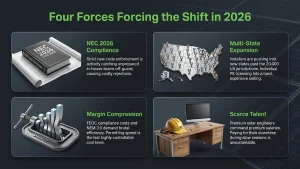
Margin compression is real. Between FEOC compliance costs, supply chain normalization, and NEM 3.0 disruption in California, installer margins are under pressure. Permitting inefficiency is one of the few controllable cost levers remaining — and most teams aren’t treating it as one.
Engineering talent is expensive and scarce. Experienced solar engineers command premium salaries. During project gaps, that overhead is entirely unproductive. You’re paying for availability, not output — and that gap widens during every seasonal slowdown.
Stop the Hidden Leak. Start Scaling.
Outsourcing your solar permitting removes the bottleneck — but you still need visibility over every project in your pipeline.
EnergyScape Renewables delivers PE-stamped plan sets across all 50 states with 24–48 hour turnaround, a 99% AHJ first-submission approval rate, and NEC 2026 compliance built into every deliverable. Their pay-per-project model means you scale without adding headcount, carrying idle overhead, or worrying about multi-state licensing gaps. Whether you’re running 20 projects a month or 200, EnergyScape Renewables grows with your pipeline. Get a quote at energyscaperenewables.com.
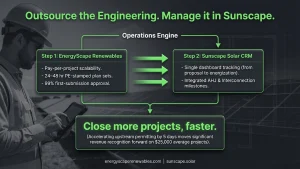
Once the permitting is outsourced, the next challenge is tracking it. Where does each job stand in the AHJ queue? Has interconnection been submitted? What’s the PTO timeline? Sunscape Solar CRM gives you a single dashboard tracking every project from proposal to energization — permit status, AHJ submission dates, interconnection milestones, and PTO deadlines — all integrated directly with EnergyScape’s engineering workflow. Visit sunscape.solar to explore how it fits your operation.
Outsource the engineering. Manage it in Sunscape. Close more projects, faster.
Get your free demo with Sunscape Now >
Get your free consultation with Energyscape Renewables Here >
Frequently Asked Questions: Solar Permitting Outsourcing
Q: How much does solar permitting outsourcing cost per project? Residential PE-stamped plan sets from third-party providers typically cost $150–$400, depending on jurisdiction and project complexity. Commercial projects range higher. Compared to the fully loaded in-house cost of $530–$810+ per project in engineering overhead, outsourcing delivers a measurable per-project savings.
Q: Can one outsourced engineering partner handle all 50 states? Yes. Partners like EnergyScape Renewables maintain a nationwide PE network covering all 50 states. This means you can expand into new markets — Texas, California, Florida, Colorado, or anywhere else — without hiring state-specific engineers or paying new licensing fees.
Q: What is the typical turnaround time for outsourced solar PE stamping? Residential projects generally return PE-stamped plan sets in 24–48 hours when documentation is complete. Complex commercial installations may require 5–7 business days. That residential turnaround is significantly faster than most in-house teams can deliver during peak season volume.
Q: Does outsourcing hurt our first-submission approval rate? The opposite is true for specialized providers. EnergyScape Renewables delivers a 99% AHJ first-submission approval rate because their team handles AHJ-specific requirements daily across thousands of jurisdictions — something no single in-house team can replicate at scale.
Tag:
how much does solar permitting cost per project in-house vs outsourced solar engineering NEC 2026 solar permitting compliance outsource solar permitting outsource solar permitting services solar EPC outsource engineering plan sets solar installer multi-state permitting challenges solar permit resubmission cost and delay Solar Permitting solar permitting outsourcing cost savings 2026 solar permitting services

1 Comment
[…] plan sets typically run $150 to $400. Compare that with $530 to $810+ fully loaded in-house, as our solar permitting outsourcing cost breakdown shows. Likewise, holding PE licenses in many states is expensive. Our guide to PE stamp costs in […]