
Structural Engineering Report For Solar: Guide For 2026

Structural Engineering Report for Solar: A State-by-State Guide for US Installers
Does every solar installation need a structural engineering report? Not always — but it depends on your state, system size, roof type, and the specific AHJ. Commercial projects, systems over 10 kW in states like California, all Florida installations, and any job on a pre-1990s building almost always require one. When in doubt, get the report. A permit rejection costs more than the engineering.
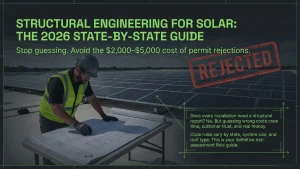
Getting a structural engineering report for solar wrong costs real money. Permit rejections, crew rescheduling, and customer delays run anywhere from $2,000 to $5,000 per project — and that’s before you factor in multi-state work where the rules shift from county to county.
So when do you actually need one? This guide breaks it down by state, system size, and roof type — so you can assess your risk before you even touch the permit application.
Why There Is No Single National Standard
There is no federal rule that tells you when a structural engineering report for solar is required. Requirements vary by state, by AHJ (Authority Having Jurisdiction), by system size, and by roof type. What clears in Charlotte can get flagged in Raleigh. What sails through Austin can stall in Houston.
That said, clear patterns exist across the country. Understanding them helps you stop guessing and start submitting clean packages the first time.
The governing codes that structural engineers work from are the International Building Code (IBC) and International Residential Code (IRC). Since 2015, both have included specific provisions for rooftop PV systems. The 2024 IBC now references ASCE 7-22, the updated American Society of Civil Engineers standard that sets the load calculation methodology for wind, snow, and seismic forces on solar installations.
When Is a Structural Engineering Report for Solar Always Required?
Certain project types consistently trigger structural analysis across most US states. Here is what to watch for.
Commercial and Industrial (C&I) Rooftop Projects
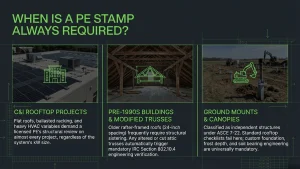
Most AHJs require a licensed PE’s structural review on any commercial rooftop installation, regardless of system size. Flat roofs, ballasted racking systems, HVAC equipment, and aging building stock all create variables that standard residential checklists cannot cover.
System Size Thresholds
Many states use kW thresholds as the trigger. In California, structural PE stamps are required for rooftop systems exceeding 10 kW. In states without an explicit threshold, most AHJs still want a structural letter for larger systems. According to the Database of State Incentives for Renewables & Efficiency (DSIRE), PE stamp requirements vary significantly by state and even by utility district.
Buildings Constructed Before the Early 1990s
Any structure built before modern building codes should have a licensed structural engineer confirm load capacity before panels go up. Older rafter-framed roofs — especially those with 24-inch rafter spacing — may require sistering or reinforcement. This step is not optional.
Hurricane and Wind Zones
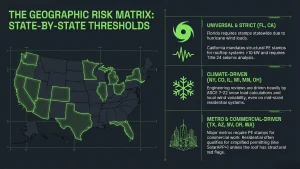
Florida is the clearest case. A structural PE stamp is mandatory on virtually every solar installation in the state, driven entirely by hurricane zone wind load requirements. Coastal Texas faces similar scrutiny. If your project is within a FEMA Special Flood Hazard Area or a high-wind zone, plan on engineering review.
Seismic Zones
California requires seismic analysis under both ASCE 7 and Title 24. Northern California hillside properties and high-rise installations often require wet stamps in addition to standard PE review. Oregon and Washington also mandate structural engineering for commercial rooftop work in higher seismic zones.
Ground-Mount Systems
Ground mounts require custom structural engineering for foundation design — including soil testing, frost depth analysis, and bearing capacity verification. No standard checklist covers a ground mount adequately.
Solar Carport and Canopy Structures
Freestanding carport canopies are classified as independent structures under ASCE 7-22. They require PE-stamped structural design, foundation engineering, and clearance calculations. This is full custom engineering on every job, every time.
Modified or Damaged Roof Trusses
If your attic inspection reveals altered, cut, or damaged trusses, a structural engineer must be involved. IRC Section 802.10.4 is explicit: any addition of load to modified trusses requires engineering verification. Do not skip this step.
State-by-State Structural Engineering Report For Solar at a Glance
| State | Structural PE Stamp Required? | Key Threshold / Notes |
|---|---|---|
| California | Yes — residential & commercial | Rooftop systems >10 kW; seismic + Title 24 add layers |
| Florida | Yes — virtually all projects | Hurricane zone wind loads; manual review statewide |
| New York | Yes — most commercial | NYC especially stringent; snow + wind load variability |
| Texas | Varies by jurisdiction | Major metros require for commercial; coastal = stricter |
| Colorado | Yes — most projects | Snow and wind load review; mountain-tier requirements |
| Arizona / Nevada | Larger systems and C&I | Residential often qualifies for simplified permitting |
| Illinois / Michigan / Ohio / Minnesota | Yes — most commercial | Snow load drives review even on mid-size systems |
| Georgia / NC / SC | Commercial and complex residential | Roof load concerns trigger PE review |
| Oregon / Washington | Commercial and higher seismic zones | Required for rooftop evaluations in commercial work |
Does Roof Type Change the Requirement?
Yes — even in permissive markets, roof type can push a job into structural engineering territory. Here is what to flag during your site survey:
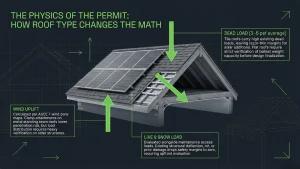
- Flat / low-slope roofs with ballasted racking — ballast weight (typically 4–5 psf average) requires capacity verification before finalizing the design
- Tile roofs — existing dead load is already high, leaving less margin for solar additions
- Metal standing seam roofs — lower penetration risk with clamp attachment, but load distribution still needs verification on older structures
- Rafter-framed homes with 24-inch spacing — frequently require sistering under current code, especially in snow load regions
- Any roof showing deflection, rot, or prior damage — requires structural evaluation before design begins
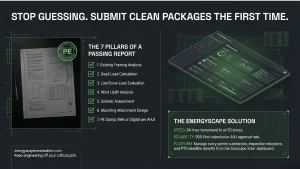
What Does a Structural Engineering Report Actually Include?
A complete structural engineering report for solar typically covers:
- Existing roof framing analysis — rafter or truss type, spacing, span, and current load capacity
- Dead load calculation — panel weight, racking, hardware (typically 3–5 psf for flush-mounted systems)
- Live load evaluation — snow accumulation and maintenance access loads
- Wind uplift analysis — calculated per ASCE 7 wind zone maps for the specific project location
- Seismic assessment (where applicable) — site class and design spectral values
- Mounting attachment design — spacing, lag bolt depth, and pull-out resistance calculations
- PE stamp and wet or digital seal — per the AHJ’s accepted format
Some jurisdictions accept digital PE seals; others still require wet stamps. Submitting the wrong format can cost two to three weeks on an otherwise clean package.
Stop Guessing — Get Engineering That Passes the First Time
Every permit package that goes out the door without proper structural documentation is a rejection waiting to happen. And rejections don’t just delay one job — they back up your entire pipeline.
EnergyScape Renewables delivers PE-stamped structural analysis and site surveys across all 50 states with a 24-hour turnaround and a 99% first-submission AHJ approval rate. Their licensed structural engineers evaluate roof capacity, calculate loads per ASCE 7-22, and produce permit-ready documentation that AHJ reviewers don’t have to question.
Whether you’re running residential volume in Florida, scaling into Colorado commercial work, or tackling a complex ground-mount in Texas, EnergyScape keeps engineering off your critical path.
👉 Get started at energyscaperenewables.com
Once your structural engineering is locked, manage every permit submission, inspection milestone, and PTO deadline from a single dashboard with Sunscape Solar — the CRM and project management platform purpose-built for US solar installers and EPCs.
👉 Explore Sunscape Solar at sunscape.solar
Frequently Asked Questions: Structural Engineering Report For Solar
Does every residential solar installation require a structural engineering report?
No. Simple residential systems on newer homes (post-1990) with standard shingle roofs and conventional rafter spacing often qualify for simplified permitting in many AHJs — especially where SolarAPP+ is available. However, system size, location, roof condition, and the specific AHJ’s requirements can change that quickly.
What system size triggers a structural PE stamp requirement?
California requires structural PE stamps for rooftop systems exceeding 10 kW. Texas and Arizona have no statewide residential threshold, but commercial projects in major metros typically trigger review. In Florida, PE stamps are required on virtually every project regardless of size.
Do ground-mount solar systems need a structural engineering report?
Yes — always. Ground mounts require custom foundation design based on soil testing, frost depth, and local wind and seismic data. Standard rooftop checklists do not apply.
What is the difference between a structural PE stamp and an electrical PE stamp for solar?
A structural PE stamp certifies the mounting system’s load capacity and building compatibility. An electrical PE stamp certifies system design, wire sizing, and NEC compliance. Many projects require both. Electrical PE stamps typically kick in for systems over 50 kW in most jurisdictions, though some states set lower thresholds.
Can I use the same structural letter on multiple projects?
No. Structural engineering reports are site-specific. They are based on the exact roof framing, load conditions, and local climate data for that specific address. A letter from one project cannot be reused on another.
sjayakanth@energyscaperenewables.com