
Roof Attachment Calculations in a PE Stamp: What Engineers Check and Why It Matters for Your AHJ Approval

Why Roof Attachment Calculations Are Failing Solar Permits
You submitted a clean plan set. The electrical design looked solid. The AHJ still kicked it back — flagged on structural. Sound familiar?
For many solar installers and EPCs, this scenario is painfully common. Permit rejections tied to roof attachment calculations are one of the biggest pipeline killers in rooftop solar. The root cause is almost always the same: incomplete or generic structural documentation in the PE stamp.
Roof attachment calculations are not a back-of-the-plan-set formality. Instead, they are the structural backbone of your entire permit package. They tell the Authority Having Jurisdiction that a licensed PE has verified the roof can carry the load. Panels, racking, hardware, wind, snow — all of it. When those calculations are off, your project waits. This blog breaks down exactly what engineers check, and why each piece drives your AHJ approval.
What Engineers Actually Review in Roof Attachment Calculations
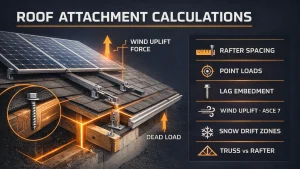
When a structural PE reviews your project, the analysis goes well beyond panel weight. Each layer feeds directly into whether your plan set clears AHJ review on the first submission.
Rafter Size, Spacing, and Existing Condition
First, the engineer verifies the existing roof framing. This means actual rafter dimensions, on-center spacing, and current condition. Most residential US roofs use rafters spaced 16 or 24 inches on center. That spacing, however, matters significantly when calculating load distribution.
For example, attaching to every other rafter at 24-inch spacing creates a 48-inch span. That changes the bending moment calculation entirely. Engineers also check for sag. Per standard structural criteria, rafter deflection in inches should not exceed the span in feet divided by 20. Rafters that fail this benchmark need reinforcement before solar can go on.
Point Loads at Each Attachment Point
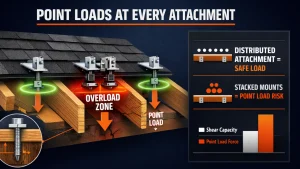
One commonly misunderstood aspect of solar structural engineering is how mounting hardware transfers load. Panels and racking are not a uniform blanket of weight. Instead, each lag bolt and standoff creates a concentrated point load at a specific rafter location.
Consequently, when attachment spacing is too wide — or mounts stack on the same rafter across multiple rows — that point load intensifies. The PE confirms that each attachment point stays within the rafter’s shear and bending capacity. This is why your racking layout is not just a product decision. It is, above all, a structural calculation input.
Lag Bolt Pullout Resistance and Embedment Depth
Next, engineers review lag screw selection and embedment carefully. Pullout resistance depends on the wood species and grade, the bolt diameter, and how deep the lag embeds into the rafter. Minimum embedment is typically 2.5 inches into the rafter beyond the sheathing. Some AHJs or load conditions, however, require more.
This becomes especially important on roofs with layered reroofing. Additional shingle layers reduce effective lag embedment. As a result, pullout resistance drops — sometimes enough to require heavier hardware or more attachment points. If your plan set doesn’t document embedment depth specifically, many AHJs will flag it immediately.
Wind Uplift Using ASCE 7

Wind is the force that trips up the most plan sets in coastal and high-wind markets. Engineers calculate wind uplift using ASCE 7, the standard structural loading reference. They pull the design wind speed for the specific project address, exposure category, and roof geometry.
Attachment points must resist both downward dead load and upward wind force. In high-wind markets — Florida, Gulf Coast Texas, the Carolinas — this is where attachment count and hardware specs most often increase beyond standard layout. Without location-specific wind load calculations, moreover, AHJs in these markets will almost always flag the submission.
Snow Load and Panel Drift Zones
Snow load gets more complicated when solar panels are involved. Panels can shed snow faster than shingles due to their slick surfaces. Nevertheless, they also create edge drift zones where snow builds up — concentrated loads at the panel perimeter that standard tables don’t fully capture.
Engineers reference ASCE 7 ground-to-roof conversion factors, adjust for slope and thermal conditions, and account for these drift zones. This step matters particularly in northern markets and high-altitude installations. States like Colorado, Wyoming, and the upper Midwest require careful snow load review on every rooftop project.
Truss Systems vs. Rafter Systems
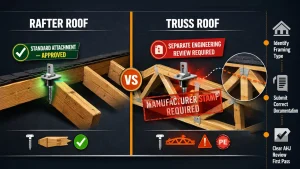
Finally, one detail that regularly catches installers off guard is the difference between truss-framed and rafter-framed roofs. Trusses are engineered systems. Therefore, any modification or point load applied to a truss chord without a stamp from the original truss manufacturer — or a qualified structural engineer — can void the truss design entirely.
An attachment that’s straightforward on a rafter roof requires a separate engineering review on a truss. Some AHJs specifically ask which framing type is in use and require documentation accordingly. Getting this wrong means a revision cycle, not just a comment.
Why AHJs Are Tightening Structural Review in 2026
Building departments nationwide have raised their standards as rooftop solar volume has grown. California enforces NEC 2026 alongside strict seismic loading requirements under CBC and ASCE 7. Florida, meanwhile, mandates PE stamps with site-specific wind load calculations on virtually every installation — no size exemptions. Texas AHJs vary by municipality. However, larger metro departments are increasingly requesting more detailed structural documentation than just two years ago.
The takeaway is straightforward. Generic structural letters and templated PE stamps are losing their first-pass rate. AHJs want calculations that reference the actual project address, actual framing specs, and actual wind or snow design values for that jurisdiction. Roof attachment calculations must be project-specific to pass.
How EnergyScape Renewables Delivers PE-Stamped Structural Engineering
This is the exact engineering depth that EnergyScape Renewables brings to every project. With licensed structural PEs in all 50 states, EnergyScape produces roof attachment calculations specific to the project site. Real rafter data, correct ASCE 7 wind zones, jurisdiction-matched code versions, and hardware specs that clear the AHJ on the first submission.
Their 24-hour turnaround and 99% first-submission approval rate mean your projects don’t stall waiting on structural revisions. Whether you’re running residential jobs in Florida’s wind zones, commercial rooftop work in California’s seismic corridors, or multi-state portfolios, EnergyScape builds structural documentation that moves through AHJ review without friction.
Additionally, once your permits are moving, keeping the whole pipeline organized is where Sunscape Solar comes in. It’s a CRM and project management platform built specifically for US installers and EPCs — tracking permitting timelines, structural approvals, and every milestone from plan set submission to PTO, all in one place
sjayakanth@energyscaperenewables.com