
Scale Solar Installation Multiple States — The Smart Way in 2026

Then Scale Solar Installation Multiple States — The Smart Way
Scale Solar Installation Multiple States: You’ve built a strong solar installation business in your home state. Your crews are efficient. Your customers are happy. Now you want to grow. So you ask the obvious question — which states do we move into next?
That question sounds simple. However, what follows is anything but. Most solar installers who try to scale solar installation multiple states hit the same wall. Licensing research. Engineer hunting. AHJ confusion. And suddenly a six-week project bleeds into four months.
The good news is that you don’t need to build a local engineering team in every state you enter. In this guide, you’ll learn exactly how top solar installers and EPCs are expanding across state lines — faster, leaner, and without the overhead.
Why Scale Solar Installation Multiple States Lines Is So Hard
Scaling solar into new states creates friction at every level of your project workflow. Therefore, understanding exactly where that friction comes from is the first step.
Here are the four biggest barriers installers face:
1. Licensing rules change completely at every border. Some states require a dedicated solar contractor license — like California’s C-46 or Florida’s certified solar contractor credential. Others require an electrical or general contractor license. A few states don’t license at the state level at all and push it down to city and county boards. According to the Interstate Renewable Energy Council’s National Solar Licensing Database, requirements vary dramatically across all 50 states and continue to evolve each year.
2. PE stamp requirements are different in every market. A Professional Engineer licensed in Texas cannot legally stamp plans in Georgia. California requires structural PE stamps for rooftop systems over 10 kW and electrical stamps above 50 kW. Florida mandates PE stamps on virtually every installation due to hurricane zone regulations. Texas has no statewide standard — requirements shift city by city. Consequently, every new market you enter means a new engineering relationship to build.
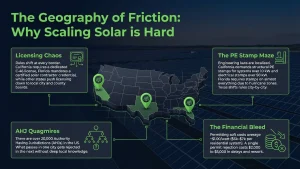
3. AHJ knowledge takes years to develop. There are over 20,000 permitting jurisdictions across the United States. What passes in Charlotte may get rejected in Raleigh. Because each AHJ sets its own standards, local knowledge is a real competitive advantage — and it takes time to build.
4. Soft costs compound fast in unfamiliar markets. Permitting and inspection overhead averages around $1.00 per watt on residential projects — roughly $6,000 to $7,000 on a typical system. In a new state, without existing relationships, that number rises. Moreover, a single permit rejection typically costs $2,000 to $5,000 per project in delays and rework.
The Real Cost of Building Local Engineering Teams
Many growing solar installers try to solve the multi-state problem by hiring. They bring on an in-house PE or form relationships with local engineering firms in each target market. On the surface, that sounds reasonable. However, the numbers tell a different story.
A licensed Professional Engineer with solar experience typically costs $90,000 to $130,000 per year in salary — before benefits and overhead. And that engineer can only stamp plans in states where they hold a license. If you work across five states, you need five credentialed engineers, or one firm that covers them all.
Beyond salaries, establishing local presence takes time. State licensing board processing times can run weeks to months, depending on application backlogs. Furthermore, the AHJ-level knowledge you need — which inspectors are strict about labeling, which jurisdictions run NEC 2023 versus NEC 2020 — takes years of project history to accumulate.
For a regional EPC scaling fast, that model simply doesn’t work. By the time your local team is built, the market window may have already shifted.

The Smarter Approach: On-Demand Engineering Across All 50 States
The solar companies growing successfully into new markets right now aren’t building local teams first. Instead, they partner with engineering firms that are already licensed, already experienced, and already working in every state they want to enter.
This model works because it decouples your fixed costs from your growth. You pay per project, in the states where you’re active, as your volume grows. As a result, overhead stays lean and cash flow stays predictable.
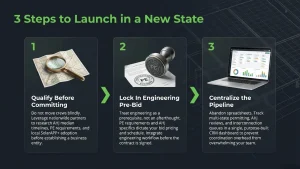
Here’s the three-step workflow successful multi-state installers use:
1. Qualify the Market Before You Commit
Before moving crews or registering a business entity in a new state, research the permitting environment first. What is the median permit approval timeline? Are PE stamps required for residential, commercial, or both? Does the state have SolarAPP+ adoption that could fast-track approvals? A nationwide engineering partner should answer these questions from direct experience — not from a Google search.
2. Lock In Engineering Before the First Bid Goes Out
One of the most common mistakes installers make in new markets is treating engineering as an afterthought. In practice, PE stamp requirements, AHJ documentation specifics, and interconnection timelines all affect your bid pricing and your project schedule. Therefore, nail the engineering workflow before you close the first job — not after.
3. Track the Multi-State Pipeline in One Place
When you run projects across several states at once, coordination overhead can overwhelm your team fast. You need real-time visibility into where each project stands in permitting, which AHJ is reviewing what, and where your interconnection queue sits. A purpose-built solar CRM solves this. (See the internal link section below for our guide on solar project management best practices.)
What to Look for in a Nationwide Solar Engineering Partner
Not every engineering firm can handle multi-state solar work at volume. When you evaluate partners for your expansion, focus on these five criteria.
Licensed PEs in all 50 states. Not a referral network — a team that covers every jurisdiction from day one, without you making calls to find the right contact.
Fast turnaround with consistent quality. A 24-hour residential plan set turnaround and 24-to-48 hours for commercial work keeps your sales pipeline moving. Slow engineering kills deals.
Solar-specific expertise. A solar-specialized firm already understands NEC Article 690, FEOC compliance, rapid shutdown configurations, and AHJ quirks. Generic firms make you explain the basics every single time. For more on NEC compliance requirements, read our guide on NEC 2026 solar code updates for installers.
A strong first-submission AHJ approval rate. A 99% first-submission approval rate is the difference between a predictable timeline and constant revision cycles eating into your margin.
Full-stack engineering services. Structural stamps, electrical stamps, interconnection support, and complete permit-ready plan sets — all from one partner, not three separate vendors.
The ITC Deadline Makes Speed Non-Negotiable
Commercial and industrial EPCs face additional urgency in 2026. To lock in the Investment Tax Credit’s four-year project completion window, construction must begin by July 4, 2026. That means permitting, engineering, and interconnection applications for new-market commercial projects need to move now.
Standing up a local engineering operation takes months. In contrast, a nationwide engineering partner can produce permit-ready plan sets within 24 hours. For EPCs targeting new states before the ITC window closes, that speed gap is the difference between capturing a project and losing it.
Real Talk: What Multi-State Expansion Still Requires From You
There is no shortcut for every part of expansion. You still need to register your business entity in new states. Then you need to ensure your contractor licensing covers the scope of work you’re bidding. After that you still need to build relationships with local subcontractors and sales teams.
However, the engineering and permitting piece — historically one of the biggest bottlenecks — no longer has to slow you down. When your engineering partner is already licensed and actively working in every state you’re targeting, that piece is solved before you sign your first out-of-state contract.
The installers winning in multiple markets share one thing in common. They didn’t wait to build local teams before selling. Instead, they built the right partnerships, structured their workflows for volume, and let the engineering infrastructure carry the compliance weight.
Ready to Enter New Markets Without Building Local Engineering Teams?
If you’re a solar installer or EPC ready to expand beyond your home state, EnergyScape Renewables is the engineering partner built for exactly this. They’re already licensed and experienced in every state — with 24-hour PE stamping, a 99% AHJ first-submission approval rate, and full-stack services covering structural stamps, electrical stamps, interconnection, and permit-ready plan sets.
→ Enter new markets instantly: energyscaperenewables.com
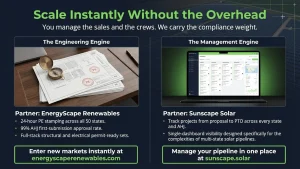
Once your pipeline spans multiple states, managing it is its own challenge. Sunscape Solar is the purpose-built CRM and project management platform for solar installers and EPCs — tracking every project from proposal through PTO, across every state you work in, from a single dashboard.
→ Manage your multi-state pipeline in one place: sunscape.solar
Frequently Asked Questions: Scale Solar Installation Multiple States
Do I need a PE stamp in every state where I install solar? Yes, in most cases. PE stamp requirements vary by state and system size, but most commercial projects over 10–15 kW require engineering review regardless of location. Florida mandates stamps on virtually all installs. California requires them for systems over 10 kW (structural) and 50 kW (electrical). In Texas, requirements vary by city. Always verify with the specific AHJ before bidding.
How long does solar contractor licensing take in a new state? Processing times vary significantly. Some state boards issue licenses within two to four weeks. Others run three to six months depending on application volume and exam scheduling. Consequently, research licensing timelines before committing to a project start date in an unfamiliar state.
Can I scale solar installation across multiple states without hiring local engineers? Yes. Partnering with a nationwide engineering firm that holds PE licenses across all 50 states eliminates the need for local engineer relationships in each market. Firms like EnergyScape Renewables are built specifically for this use case, with 24-hour turnaround and jurisdiction-specific expertise across every state.
What is an AHJ and why does it matter for multi-state solar? AHJ stands for Authority Having Jurisdiction — the local body that reviews and approves your permit applications. There are over 20,000 AHJs in the US, and each one has its own documentation preferences, code adoptions, and review timelines. Multi-state installers who work with engineering partners experienced across many AHJs get faster first-submission approvals.
What solar project management tools help with multi-state expansion? A purpose-built solar CRM tracks every project from lead through Permission to Operate, across all states and AHJs, in one dashboard. This eliminates the coordination overhead that typically grows out of control as installers scale into new markets.
sjayakanth@energyscaperenewables.com