
The 7 elements every commercial solar proposal needs to get a “yes” from a CFO
Why Most Commercial Solar Proposals Never Get Approved
You’ve done the site walk. You’ve run the numbers. The project makes financial sense. Yet your commercial solar proposal lands on the CFO’s desk — and dies there. Sound familiar? Most lost commercial solar deals aren’t lost because solar doesn’t pencil out. Instead, they’re lost because the proposal doesn’t speak the CFO’s language. CFOs don’t lose sleep over kilowatt-hours. They think in payback periods, net present value, and capital risk. So once you understand what a CFO actually needs to see, you can build your commercial solar proposal to answer every question before it’s even asked. As a result, your close rate on commercial projects improves dramatically.
The 7 Elements Every CFO Needs to See Before Signing Off

1. A Clear, Verified Energy Baseline
First, a CFO needs to see where the company currently stands on energy spend. Pull 12 to 24 months of utility bills. Then present a monthly consumption breakdown, average cost per kWh, and peak demand charges. This baseline does two things. It validates the problem you’re solving. Moreover, it anchors every savings projection that follows.
Skipping this step is one of the fastest ways to lose credibility. Relying on estimated figures is just as bad. When you show a rigorous energy audit alongside your commercial solar proposal, decision-makers know the downstream numbers are grounded in reality — not guesswork.
2. A Straightforward Commercial Solar ROI Model
Commercial solar ROI is the centerpiece of any winning proposal. Present it cleanly, not buried in appendices. At minimum, your ROI section should cover total installed system cost, estimated annual energy savings in dollars, simple payback period, Net Present Value (NPV) over 25 years, and Internal Rate of Return (IRR).
CFOs benchmark IRR against their company’s minimum acceptable rate of return. Therefore, proposals targeting an IRR between 10% and 15% consistently clear that hurdle for most commercial enterprises. Show that number clearly. Suddenly, solar stops competing against operational expenses. Instead, it competes against other capital investments — and that’s a much easier conversation to win.
3. Federal Tax Incentives and Depreciation — Spelled Out Completely
This is where many solar proposals leave serious money on the table. Vague incentive language kills deals. Consequently, your commercial solar proposal must include a precise incentive breakdown.

Right now, that means the 30% Investment Tax Credit (ITC) under Section 48E. It also means 80% bonus depreciation under current federal rules. This depreciation applies to 85% of the cost basis after the ITC reduction. Together, these two mechanisms can cut the effective project cost nearly in half in year one. Additionally, projects qualifying for the domestic content adder or energy community siting can stack an extra 10% on top.
Don’t Miss the July 4, 2026 ITC Deadline
For commercial systems under 1.5MW AC, clients must procure at least 5% of total material costs before July 4, 2026. This preserves ITC eligibility through 2030. Include that deadline prominently in your solar project financing section. CFOs respond to urgency — but only when it’s backed by a real regulatory calendar, not a sales pitch.
4. Solar Project Financing Options — More Than One Path
CFOs think about capital structure. So should your proposal. Present multiple solar project financing scenarios side by side. These include direct purchase (highest ROI, 5–7 year payback), Power Purchase Agreement or PPA (zero upfront, immediate monthly savings), commercial solar loan, and C-PACE financing for eligible commercial real estate.
Each path has different implications for the balance sheet. Each also affects tax appetite and cash flow differently. Presenting just one option forces a binary yes/no decision. In contrast, presenting multiple options opens a collaborative conversation. That’s a far easier meeting to win.
5. System Design with Transparent Performance Assumptions
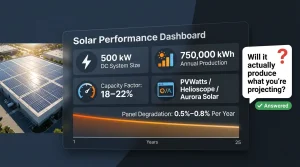
A CFO won’t scrutinize panel tilt angles. However, they do need confidence that projected energy production numbers are defensible. Include your design summary clearly. Cover system size in kW DC, estimated annual production in kWh, capacity factor, and the modeling tool used — PVWatts, Helioscope, or Aurora Solar.
Also, disclose the assumed panel degradation rate. This typically runs between 0.5% and 0.8% annually. Show how it factors into the 25-year production model. This transparency directly addresses the most common objection in commercial solar review meetings: “How do we know the system will actually produce what you’re projecting?” Answer it proactively, before anyone asks.
6. Permitting, Interconnection, and a Realistic Project Timeline
Nothing stalls a commercial deal faster than uncertainty around timelines. Get ahead of that concern. Your commercial solar proposal should include a project timeline covering PE-stamped plan set preparation, AHJ permit submission and approval, utility interconnection application, and construction through commissioning.
Be specific about jurisdictions your team has worked in. Moreover, lead with your AHJ approval rate if it’s strong. For solar installers working with an experienced engineering partner, this section writes itself. The permitting expertise is already built in — and decision-makers can see that clearly.
7. ESG and Long-Term Sustainability Value

In 2026, more commercial solar decisions are being shaped by board-level ESG mandates. Investor reporting requirements also play a growing role. As a result, your commercial solar proposal should go beyond the financial return. Quantify the annual carbon offset in metric tons. Include the equivalent homes powered. Reference alignment with applicable frameworks like LEED, GRI, or CDP.
Furthermore, note the property value impact. Buildings with solar consistently command higher valuations. They also attract sustainability-focused tenants. This section alone won’t close a deal. However, for CFOs reporting to a board with ESG obligations, it removes a key objection and adds real strategic weight to the project.
Bonus: Let the Executive Summary Do the Heavy Lifting
CFOs are busy. Therefore, lead with a tight one-page executive summary. Hit the net project cost after ITC and depreciation, simple payback period, 25-year NPV, annual CO₂ reduction, and a single call-to-action. Think of it as the proposal’s pitch deck. If the executive summary is compelling, everything else simply serves as proof.
How EnergyScape Renewables Helps You Win More Commercial Solar Deals
Building a CFO-ready commercial solar proposal means having airtight engineering behind every number. That’s exactly where EnergyScape Renewables delivers. As a full-service solar engineering firm operating across all 50 states, EnergyScape provides PE-stamped plan sets, AHJ permit-ready design packages, and interconnection support. Their 99% AHJ approval rate and 24-hour PE stamp turnaround on standard projects means your proposal’s permitting section carries real weight — not just good intentions.
Additionally, if you want to streamline how you build, track, and manage commercial solar proposals across your pipeline, Sunscape Solar is worth a close look. It’s a solar CRM and project management platform built specifically for US solar installers and EPCs. From proposal generation to permitting milestones and interconnection tracking, Sunscape keeps every commercial project moving. Ultimately, the installers and EPCs winning commercial solar deals in 2026 aren’t just selling panels. They’re presenting a financial case that a CFO can walk into a board meeting with confidence. Start with these seven elements. Back them up with solid engineering. Give decision-makers every reason to say yes.
sjayakanth@energyscaperenewables.com