
Non-Standard Solar Installations: Engineer the Hard Jobs in 2026
Non-Standard Solar Installations: Complex Roofs, Carports & Ground Mounts
Non-standard solar installations are where deals get made — or lost. Not every project lands on a clean, south-facing shingle roof. Real-world jobs throw hip roofs, dormers, carport canopies, and open-field ground mounts at you. Standard design software struggles with all of them. This guide breaks down the engineering, the 2023 NEC code updates, and the structural requirements you need to close these jobs — and close them right.
Why Standard Design Tools Struggle With Non-Standard Solar Installations
Most design platforms — Aurora, Helioscope, basic CAD — work around one core assumption: simple roof geometry with conventional racking. That assumption breaks down fast on complex sites.
Multi-plane roofs need detailed 3D shading models that flat-surface tools can’t accurately produce. Carport canopies are freestanding structures that require custom structural engineering. Ground mounts introduce soil analysis, foundation design, and setback calculations that go well beyond panel layout.

As a result, plan sets get rejected, projects stall, and — in the worst case — installations fail structurally. According to SolarReviews’ 2025 US Solar Industry Survey, permitting and interconnection delays rank as the top challenge for US solar installers. Complex site conditions make that problem significantly worse.
Complex Roof Engineering: What Your Plan Set Actually Needs
Structural Load Analysis Under ASCE 7-22
The 2024 International Building Code references ASCE 7-22 as the governing structural standard for solar installations. Engineers use it to calculate dead loads, live loads, wind uplift, and snow accumulation. On steep-slope or multi-plane roofs, wind pressure and snow drift loads vary dramatically from one roof zone to the next.
Older buildings present additional risk. Any structure built before the 1990s needs a licensed structural engineer to confirm the existing framing can carry the added dead load. Don’t skip that step.
Hip Roofs, Dormers, and Valleys
Hip roofs break your usable surface into smaller triangular and trapezoidal sections. Therefore, effective design maximizes each section while maintaining fire code setbacks and clean wire runs. Dormers create shading zones that require accurate 3D modeling — not the flat-plane approximations most tools default to. Valleys introduce leak risk at every penetration point, so waterproofing details must be included in your permit documents.

Flat Commercial Roofs
Ballasted systems on flat commercial decks look simple. However, ballast weight distribution must account for the roof’s rated load capacity, existing rooftop equipment, and drainage patterns. Penetrating systems require full waterproofing coordination. In jurisdictions on NEC 2023, your rapid shutdown compliance path needs to appear clearly on the one-line diagram.
Solar Carports and NEC 2023: A Code Change Worth Knowing
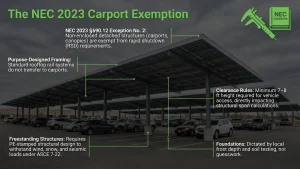
If RSD system costs have kept you from quoting carport jobs, NEC 2023 Section 690.12 Exception No. 2 changes your math. The 2023 code explicitly exempts non-enclosed detached structures — including solar carports, canopies, parking shade structures, and trellises — from rapid shutdown requirements. Firefighters don’t perform rooftop operations on open-sided structures, so the RSD safety requirement simply doesn’t apply.
This exemption reduces both cost and complexity on carport projects. However, the RSD carve-out is only part of the picture. Carport structures still require all of the following:
- PE-stamped structural design — carports are freestanding structures subject to wind, snow, and seismic loads under ASCE 7-22
- Foundation design based on soil testing — helical piles, concrete piers, or driven posts depending on site conditions and local frost depth
- Purpose-designed canopy framing — standard rooftop rail systems don’t transfer to carport structures
- Minimum 7–8 ft clearance height for vehicle access, which directly affects structural span calculations
- Integrated water management — panel runoff must route cleanly through gutters, not drip onto vehicles
- EV charging coordination — increasingly required in commercial parking installations
If your jurisdiction still runs under NEC 2020, the rapid shutdown language is less clear. However, the NEC Code-Making Panel has confirmed that the 2023 clarification reflects the original legislative intent. Some AHJs will apply it even under 2020 language. That conversation is worth having before you add RSD hardware to a carport proposal.
Ground Mount Engineering: Foundation Choice Determines Everything
Ground mounts offer the most design flexibility. But that flexibility requires you to make the right structural decisions from day one.
Choose Your Foundation Based on Soil Data — Not Price
Your foundation type — helical piles, concrete piers, driven posts, or ballasted systems — locks in your structural integrity for the full 25-year system life. Helical piles handle unstable or expansive soils well. Concrete piers deliver maximum stability but require excavation and longer timelines. Driven posts cost less but require confirmed soil-bearing capacity. Additionally, all sites in cold climates need foundation depth set below the local frost line.
No foundation type should be specified before you have soil test data. That’s where many installers create expensive problems downstream.
Fixed-Tilt vs. Tracker vs. Dual-Use Systems
Fixed-tilt arrays are the cost-efficient baseline for most projects. Single-axis trackers add 15–25% production gains at scale, but they require more complex foundation engineering and ongoing maintenance planning. Agrivoltaic and dual-use ground mounts — where crops, livestock, or stormwater management systems operate underneath — require specialized structural clearances and custom shading pattern design.
Permitting and Setback Planning
Ground mount permitting varies widely across US jurisdictions. Zoning setbacks, height limits, lot coverage rules, and visual screening requirements all apply. Utility-adjacent or commercial-scale systems may trigger interconnection studies that add months to your timeline. Scope this before your customer signs — not after. Learn more about SEIA’s interconnection resources to stay ahead of those timelines.

Custom Mounting: When Off-the-Shelf Racking Doesn’t Work
Tile roofs, standing seam metal, slate, wood shake, and corrugated metal each present unique attachment challenges. Standard rail systems don’t work on all of these substrates. Using the wrong hardware creates leak points, voids manufacturer warranties, and exposes your business to liability.
Custom mounting solutions require material-specific attachment hardware, coordinated waterproofing details, and in most cases a PE-stamped structural letter. If your racking vendor doesn’t list a compliant attachment for the substrate, bring in an engineer to design one.
The same rule applies to non-standard commercial substrates: TPO and EPDM membranes, lightweight concrete decks, and precast roof panels all have penetration and ballast limits that generic racking specs don’t cover. Our custom solar engineering services at EnergyScape Renewables handle exactly these scenarios.
Pre-Submittal Checklist for Non-Standard Solar Installations
Before your plan set goes to the AHJ, confirm each of the following:
- Confirm the governing NEC and IBC edition in your jurisdiction
- Run a full ASCE 7-22 structural analysis for all non-standard configurations
- For carports: document the NEC 690.12 Exception No. 2 compliance path in the plan set
- For ground mounts: have soil test results before selecting your foundation type
- For complex roofs: use 3D shading models — not flat-plane approximations
- Engage a licensed PE early on any project outside standard racking manufacturer specs
- Schedule a pre-application meeting with your AHJ before submitting
Quick Reference Table
| Install Type | Key Engineering Need | Governing Code |
|---|---|---|
| Complex Roof | ASCE 7-22 loads, framing check, 3D shading | IBC 2024 / IRC |
| Solar Carport | PE stamp, foundation, clearance, water mgmt | NEC 690.12 Ex. 2 |
| Ground Mount | Soil test, foundation type, setback review | IBC / Local Zoning |
| Non-Standard Substrate | Custom attachment, waterproofing, PE stamp | Mfr. Warranty / IBC |
Stop Losing Complex Solar Jobs to Engineering Gaps
Cookie-cutter software wasn’t built for carport canopies, hip roofs with dormers, or open-field ground mounts with challenging soil. When your engineering process can’t keep up with the site, you lose the deal — or worse, you close it and face a rejected plan set.
Sunscape Solar and EnergyScape Renewables deliver custom structural and electrical engineering for non-standard solar applications across the US. We handle PE-stamped carport designs, complex roof plan sets, custom mounting solutions, and utility-adjacent ground mount permitting.
Complex installation? Our structural engineers handle what cookie-cutter software can’t. Contact EnergyScape Renewables today and get a team that closes the hard jobs.
Frequently Asked Questions: Non-Standard Solar Installations
Do solar carports need rapid shutdown systems under NEC 2023? No. NEC 2023 Section 690.12 Exception No. 2 explicitly exempts non-enclosed detached structures — including solar carports, canopies, and trellises — from rapid shutdown requirements because firefighters don’t perform rooftop operations on open-sided structures.
What structural standard governs solar installations in the US? ASCE 7-22 governs structural load calculations for solar installations. The 2024 International Building Code and International Residential Code reference it as the standard for wind, snow, seismic, and dead load design.
Can you install solar on a hip roof with dormers? Yes, but it requires accurate 3D shading analysis — not flat-surface approximations — and a structural review to confirm the existing framing supports the added dead load. Working with a licensed PE on complex roof geometries prevents plan rejections.
What foundation type works best for ground mount solar? Foundation selection depends on soil conditions, frost depth, and site load requirements. Helical piles suit unstable soils. Concrete piers offer maximum stability. Driven posts work well where soil bearing is confirmed. A soil test before selection is non-negotiable.
What’s the biggest mistake installers make on non-standard solar jobs? Skipping the structural engineer until after plan submission. For any job outside standard racking specs — carports, complex roofs, non-standard substrates — early PE involvement prevents rejected plan sets, redesign costs, and project delays.
sjayakanth@energyscaperenewables.com