
How to Choose Between In-House and Outsourced Solar Engineering

How to Choose Between In-House and Outsourced Solar Engineering Services for Your Solar Business
Every solar installer and EPC faces a critical decision that can make or break their operational efficiency: should you build an internal engineering team or partner with outsourced solar engineering providers? This choice directly impacts your project timelines, profit margins, and ability to scale. With the solar industry projected to account for over half of global renewable capacity expansion through 2028, according to the International Energy Agency, making the right engineering decision has never been more important. Fortunately, understanding the key factors—cost structure, scalability, technical expertise, and project demand—can help you determine which solar engineering services model aligns with your business goals and growth trajectory.
Understanding Your Solar Engineering Needs
Before diving into the in-house versus outsourced debate, it’s essential to evaluate your current project pipeline and future growth plans. Solar engineering encompasses multiple disciplines including structural analysis, electrical design, PV system layouts, and compliance documentation. Moreover, each project requires PE stamps, utility interconnection plans, and AHJ-specific permit sets that demand specialized knowledge.
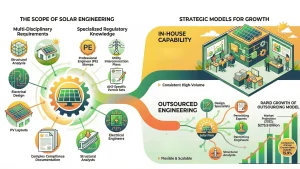
Many solar installers start with outsourced solar engineering to test market demand before committing to full-time staff. Conversely, large EPCs handling consistent project volumes may justify building internal capabilities. However, the engineering services outsourcing market is experiencing remarkable growth, projected to reach $275.9 billion by 2032 at a 15.9% CAGR, reflecting industry-wide confidence in the outsourcing model.
The Case for In-House Solar Engineering
Building an internal solar engineering team offers distinct advantages, particularly for established companies with predictable workloads. When you bring solar engineering services in-house, you gain complete control over project timelines, design standards, and quality assurance processes. Additionally, in-house engineers develop deep familiarity with your company’s workflows, preferred equipment, and client expectations.
In-house teams excel at fostering company culture and brand consistency. Your engineers become ambassadors of your values and can collaborate directly with sales and installation crews. Furthermore, proprietary design methodologies and competitive advantages stay protected within your organization rather than being shared with external partners.
Nevertheless, maintaining in-house solar engineering comes with significant challenges. Professional engineers command premium salaries, typically $80,000-$120,000 annually, plus benefits and overhead costs. Beyond compensation, you’ll need to invest in expensive design software licenses, continuing education, and professional liability insurance that can cost tens of thousands annually. Employee retention presents another hurdle, as solar engineers are in high demand and frequently receive competitive offers.
The Strategic Benefits of Outsourced Solar Engineering
Outsourcing solar engineering services has emerged as the preferred solution for many solar installers and EPCs seeking operational flexibility. This approach allows you to access specialized expertise without the burden of full-time payroll, benefits, and overhead expenses. Essentially, outsourced providers function as an extension of your team, delivering PE-stamped drawings, structural letters, and interconnection plans on demand.
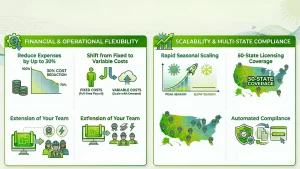
Cost efficiency stands out as the primary driver behind solar engineering outsourcing. Companies report reducing operational expenses by up to 30% through strategic outsourcing, according to recent market analysis. Instead of maintaining engineers during slow periods, you pay only for the services you need when projects require them. This variable cost structure provides tremendous financial flexibility, especially for seasonal fluctuations common in solar installation.
Scalability represents another compelling advantage. During peak seasons or when you land multiple projects simultaneously, outsourced solar engineering partners can ramp up quickly to meet demand without the lengthy hiring and training processes. Conversely, when project volume decreases, you’re not stuck with idle engineering capacity and fixed overhead costs.
Access to multi-state licensing is particularly valuable for solar installers operating across different jurisdictions. Reputable outsourced providers maintain PE licenses in all 50 states and stay current with evolving AHJ requirements, building codes, and utility standards. This eliminates the need to hire engineers licensed in each state where you operate or navigate complex reciprocity agreements.
Key Decision Factors for Solar Installers and EPCs
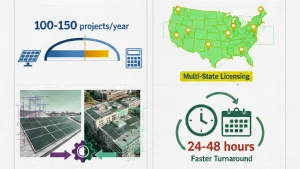
When choosing between in-house and outsourced solar engineering services, several critical factors should guide your decision. First, analyze your annual project volume and consistency. If you’re completing fewer than 100-150 projects annually, the fixed costs of in-house engineering typically exceed the variable costs of outsourcing. However, very high-volume operations might reach a crossover point where in-house becomes more economical.
Geographic diversity matters significantly. Solar installers working exclusively in one or two states may find it easier to justify hiring locally-licensed engineers. Meanwhile, regional or national EPCs benefit substantially from outsourced providers’ broad licensing coverage and multi-jurisdictional expertise.
Technical complexity should influence your strategy as well. Standard residential installations with straightforward roof structures might require less specialized engineering support. In contrast, complex commercial projects, challenging structural conditions, or unique mounting systems often demand engineering expertise that’s difficult and expensive to maintain in-house.
Timeline requirements also play a crucial role. In-house teams offer potentially faster communication and iteration cycles for revision requests. On the other hand, established outsourced solar engineering firms often deliver completed plan sets within 24-48 hours due to dedicated production workflows and larger team capacities.
The Hybrid Approach: Best of Both Worlds
Increasingly, successful solar companies are adopting hybrid models that combine strategic in-house capabilities with selective outsourcing. This approach positions core engineering leadership internally while leveraging external partners for overflow capacity, specialized expertise, or geographic coverage.
For example, you might employ one senior electrical engineer in-house to handle project oversight, client consultations, and quality review, while outsourcing PE stamps, structural letters, and detailed CAD work. This structure maintains internal technical leadership and client relationships while achieving cost efficiency and scalability through external partnerships.
The hybrid model also provides excellent risk management. During economic downturns or seasonal slowdowns, you can reduce outsourced spending immediately without difficult layoff decisions. During growth phases, external partners absorb increased demand while you selectively add permanent staff only when sustained volume justifies it.
Making Your Decision: A Practical Framework
Start by calculating your total cost of engineering per project under both scenarios. For in-house, include not just salaries but software subscriptions, insurance, training, recruitment costs, and unutilized capacity during slow periods. Compare this against quotes from reputable outsourced solar engineering providers for your typical project mix.
Next, assess your company’s growth trajectory honestly. If you’re planning aggressive expansion into new markets or project types, outsourcing provides the flexibility to test new territories without upfront engineering investments. Alternatively, if you’ve achieved stable market position with consistent volume, in-house engineering might strengthen your competitive moat.
Finally, consider your company’s core competencies and strategic priorities. If engineering excellence and design innovation differentiate your brand, investing in top-tier in-house talent makes strategic sense. However, if your competitive advantage lies in sales execution, installation efficiency, or customer service, outsourcing engineering keeps your focus on what you do best.
Conclusion: Partner with Energyscape Renewables for Expert Solar Engineering
The choice between in-house and outsourced solar engineering services isn’t one-size-fits-all—it depends on your business size, growth plans, geographic footprint, and strategic priorities. Many successful solar installers and EPCs discover that a thoughtful combination of both approaches delivers optimal results.
Energyscape Renewables specializes in providing comprehensive solar engineering services tailored specifically for solar installers and EPCs across the United States. Our team of licensed PE engineers delivers permit-ready designs, structural letters, and utility interconnection plans with industry-leading turnaround times. Whether you need occasional engineering support or a complete outsourced solution, we scale to match your project demands.
Ready to explore how professional solar engineering services can accelerate your project pipeline? Visit Sunscape Solar to learn more about cutting-edge solar design solutions and discover how strategic engineering partnerships drive profitability and growth in today’s competitive solar market.
sjayakanth@energyscaperenewables.com