
Digital Site Survey Tools vs. Manual Methods: Which is Better for Your Business?

Transforming Solar Site Surveys: Why Your Survey Method Directly Impacts Your Bottom Line
Here’s the reality: every missed measurement, delayed project, or redesign request costs your solar business real money. Consequently, digital site survey tools are changing how installers approach site assessments. However, many solar companies still rely on traditional manual methods. The problem? Manual surveys introduce inconsistencies that lead to costly change orders and frustrated customers. Meanwhile, digital tools promise accuracy and speed, yet they come with upfront costs. Therefore, which approach actually makes financial sense?
Ultimately, the answer depends on your operation’s scale, project complexity, and growth goals. Throughout this guide, we’ll break down both approaches so you can make an informed decision.
Understanding Manual Site Survey Methods
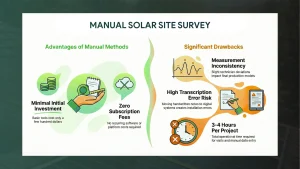
For decades, manual solar site surveys have been the industry standard. Typically, armed with a measuring tape, inclinometer, and solar pathfinder, technicians climb roofs to gather essential data. Indeed, this hands-on approach has its place.
For instance, small operations handling straightforward residential installs find manual methods cost-effective. Initially, the investment is minimal – basic tools cost a few hundred dollars. Moreover, there’s no subscription fees.
However, manual surveys come with significant drawbacks. First, measurement inconsistencies happen when different technicians approach jobs differently. Additionally, even slight deviations can impact production models. Furthermore, transcribing handwritten notes creates errors that surface during installation.
Similarly, the time factor matters tremendously. In fact, manual surveys require multiple site visits and data entry. As a result, that’s 3-4 hours of operational time per project.
The Digital Transformation: How Modern Survey Tools Work
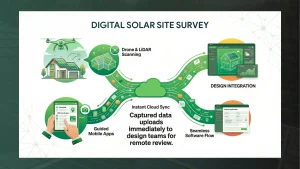
In contrast, digital site survey tools have fundamentally changed solar site assessments. Specifically, these platforms combine mobile apps, cloud storage, LiDAR technology, and automated workflows to capture data with unprecedented accuracy.
Here’s what sets digital tools apart: first, mobile apps guide field teams through standardized checklists. Second, built-in inclinometers, GPS tagging, and photo annotation eliminate guesswork. Subsequently, data syncs instantly to your design team.
Meanwhile, advanced solutions incorporate drone technology and LiDAR scanning. Instead of sending someone onto every roof, drones capture 3D models in minutes. Furthermore, LiDAR technology measures precise elevations and pitch angles automatically. Consequently, some platforms create complete “digital twins” that designers can work from remotely.
Additionally, digital site survey tools connect directly with popular solar design software like Aurora and Helioscope. Therefore, your survey data flows automatically into design workflows and permit applications.
Comparing Accuracy and Consistency
When it comes to accuracy, the gap between digital and manual methods is substantial. Clearly, digital tools eliminate human error that plagues manual surveys.
For example, consider shading analysis – the most critical component of solar site assessment. Traditionally, manual approaches rely on solar pathfinders or visual observation. In contrast, digital solutions use sophisticated algorithms to model sun paths throughout the year. As a result, this precision directly translates to accurate production estimates and better customer satisfaction.
Moreover, digital platforms enforce standardization across your team. Specifically, every surveyor follows the same checklist and records measurements identically. Undoubtedly, this consistency matters when managing multiple crews.
On the other hand, manual survey consistency depends entirely on individual technician experience. Consequently, that variability creates problems during design reviews and permitting.
Time Efficiency and Operational Impact

Now, let’s talk about what really matters: time and money. Indeed, digital site survey tools deliver dramatic time savings throughout your workflow.
Typically, a manual solar site assessment takes 2-3 hours on-site, plus another hour for data entry. In comparison, digital tools cut field time by 50-70%. Specifically, surveyors complete standardized forms in 30-45 minutes.
However, the real efficiency gains happen downstream. For instance, design teams access completed surveys within minutes. Similarly, engineers review documentation without requesting additional site visits. Additionally, permitting departments receive applications that sail through approvals.
In fact, Complete Solar reduced paperwork by 50% and saved 3-4 operational hours daily after implementing digital survey software. Remarkably, across 100 projects annually, that’s 300-400 hours returned to productive work.
Cost Analysis: Initial Investment vs. Long-Term ROI
Admittedly, the cost conversation requires honest math. Initially, manual survey equipment runs $500-1,000 per surveyor. Conversely, digital platforms typically charge $100-300 monthly per user.
At first glance, manual methods appear cheaper. However, this analysis misses hidden costs of errors and delays.
First, every change order costs money. When inaccurate measurements require design revisions, you’re losing direct costs and opportunity costs. Moreover, failed inspections delay revenue recognition.
Fortunately, digital tools prevent these expensive scenarios. Subsequently, the upfront investment pays back through faster project cycles. In fact, most solar installers report ROI within 6-12 months.
Additionally, scalability matters tremendously. Unfortunately, manual methods don’t scale efficiently. In contrast, digital platforms maintain quality regardless of team size.
Making the Right Choice for Your Solar Business
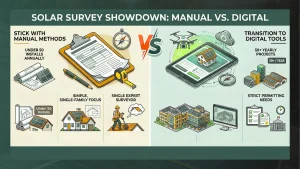
So which approach fits your operation? Essentially, the decision framework breaks down like this:
Stick with manual methods if you:
- Complete fewer than 50 residential installs annually
- Focus exclusively on simple, single-family homes
- Have a single surveyor with extensive experience
Transition to digital site survey tools if you:
- Handle 50+ projects yearly or plan to grow
- Work on commercial or complex residential projects
- Manage multiple survey teams across different locations
- Face strict permitting requirements demanding detailed documentation
Interestingly, many successful solar installers adopt a hybrid approach initially. Specifically, they maintain manual tools for backup while implementing digital platforms gradually. Thus, this allows teams to build comfort with new workflows without disrupting projects.
Ultimately, the key is recognizing that site survey quality directly impacts every subsequent phase. Therefore, investing in better survey methods isn’t optional anymore – it’s fundamental to operating a competitive solar business in 2026.
Partner with Industry Experts Who Understand Your Challenges
Certainly, choosing between digital site survey tools and manual methods represents one decision among many that solar installers face daily. From engineering to PE stamping, every phase demands expertise.
That’s where EnergyScape Renewables comes in. As a leading solar engineering services company, we provide comprehensive PE stamping, permitting, and design services across all 50 states. Furthermore, our team understands your challenges because we work with installers daily.
Whether you’re leveraging digital tools or transitioning from manual methods, EnergyScape Renewables delivers the engineering support you need. Indeed, we combine technical expertise with practical industry knowledge.
For project management, consider exploring platforms like Sunscape Solar that integrate seamlessly with modern survey workflows. Ultimately, the right combination of tools and expertise creates the foundation for sustainable growth.
The future of solar site surveys is clear: precision, efficiency, and scalability win. The only question is when your business will make the shift.
sjayakanth@energyscaperenewables.com