
Solar CRM Features 2026: 7 Essential Tools for EPCs

Solar CRM Features 2026: Essential Tools to Survive the Post-Tax Credit Era
Why Solar CRM Features 2026 Will Make or Break Your Business
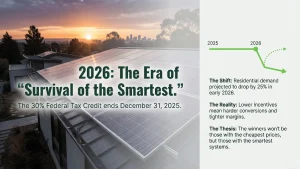
Solar CRM features 2026 matter more than ever before. With the 30% federal residential solar tax credit ending December 31, 2025, installers face their toughest market challenge yet. The companies thriving in 2026 won’t have the cheapest prices—they’ll have the smartest systems.
Here’s what changed: Lower incentives mean harder customer conversions. Additionally, tighter margins leave zero room for inefficiency. Moreover, rising customer acquisition costs make every lead precious. According to the Solar Energy Industries Association (SEIA), the residential market will undergo significant transformation as homeowners adjust to life without the 30% ITC.
Your customer relationship management software isn’t optional anymore. Instead, it’s your competitive survival tool.
What Happened to the Federal Solar Tax Credit?
First, let’s clarify what installers are facing. The residential Investment Tax Credit (ITC) allowed homeowners to claim 30% of their solar system costs as a federal tax credit. However, new legislation ended this consumer-claimed credit after December 31, 2025.
Consequently, residential solar demand dropped approximately 25% in early 2026, according to Solar.com market analysis. Nevertheless, third-party ownership arrangements—leases and Power Purchase Agreements—still qualify for the 48E tax credit through 2027.
Furthermore, this creates opportunities for installers who adapt their business models quickly.
The 7 Essential Solar CRM Features 2026 Demands
1. Automated Lead Management Systems That Never Sleep
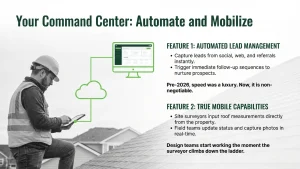
Solar CRM features 2026 must include intelligent lead automation. Why? Because research from Velocify analyzing over 3 million leads proves that contacting prospects within one minute improves conversion by 400%. After 5-24 hours, that advantage plummets to just 17%.
Your lead management system should:
- Automatically capture leads from websites, social media, and referrals
- Instantly assign leads to appropriate salespeople based on territory
- Trigger immediate follow-up sequences without manual intervention
- Score leads based on behavior and demographic data
- Nurture prospects through extended sales cycles with automated touchpoints
2. Project Management Features That Prevent Costly Delays
Every project delay costs money. Previously, a one-week delay was annoying. Now, in 2026’s tighter margin environment, it threatens profitability.
Essential project management capabilities include:
- Clear visibility into every project stage from survey through PTO
- Automatic notifications when tasks become overdue
- Risk flagging for projects approaching deadline violations
- Seamless integration with engineering partners for faster turnaround
- Real-time status updates accessible to all team members
Companies leveraging 24-hour engineering turnaround need matching CRM speed. When engineering services providers like EnergyScape Renewables deliver PE-stamped plans overnight, your CRM should immediately trigger permitting workflows.
3. Document Management Built for 99% Approval Rates
Permitting delays destroy momentum and margins. Top solar companies maintain approval rates above 99% because documentation is perfect every time.
Your solar CRM features 2026 checklist needs:
- Centralized document storage for plans, permits, and contracts
- Version control preventing submission of outdated documents
- Automated document generation reducing human error
- Role-based access ensuring right people see right files
- Integration with engineering partners for seamless plan delivery
According to industry data, EnergyScape Renewables maintains a 99% AHJ approval rate across 188,520+ completed projects. This excellence requires perfect documentation that proper CRM systems enable.
4. Integration Capabilities Creating Your Solar Ecosystem
Your CRM shouldn’t do everything—it should connect everything. Successful solar businesses build integrated ecosystems where CRMs serve as command centers.
Critical integrations include:
- Engineering partners providing PE-stamped plans
- Financial platforms offering current loan and lease products
- Accounting systems tracking real-time project profitability
- Communication tools keeping customers informed automatically
- Design software creating seamless proposal-to-installation workflows
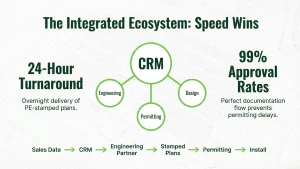
Furthermore, when engineering services flow automatically into your CRM, projects advance without manual handoffs. Speed compounds throughout your entire operation.
5. Data Analytics When Guessing Isn’t an Option Anymore
Lower margins eliminate guesswork. Your sales platform must provide clear visibility into performance metrics.
Essential reporting capabilities include:
- Conversion rates by lead source
- Average time from lead to signed contract
- Project completion rates by team member
- Profitability analysis by project type
- Real-time dashboards spotting problems early
According to EnergySage data, utility rates climb 4-6% annually. Therefore, installers need accurate ROI calculators showing customers long-term savings despite losing the 30% tax credit.
6. Mobile Access for Field Teams Working Everywhere
Sales reps aren’t desk-bound. Installation crews aren’t either. Consequently, desktop-only CRMs are obsolete in 2026.
Mobile functionality requirements:
- Full feature access from smartphones and tablets
- Offline capability for areas with poor connectivity
- Photo capture and note-taking during site surveys
- Digital form completion that automatically syncs
- Customer history access before meetings
When site surveyors input roof measurements directly into mobile CRMs, design teams start working immediately. This responsiveness differentiates winners from losers.
7. Workflow Automation Scaling Without Adding Staff
Manual processes are expensive. They require training, create bottlenecks, and introduce errors. As you grow in 2026’s challenging market, administrative overhead shouldn’t grow proportionally.
Automation should handle:
- Follow-up emails based on lead behavior
- Task assignments when projects hit milestones
- Customer updates at key project phases
- Issue flagging requiring human attention
- Report generation for team meetings
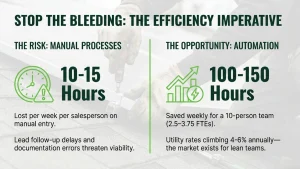
Industry studies show comprehensive automation saves 10-15 hours weekly per salesperson. In a 10-person team, that equals 100-150 hours weekly—equivalent to 2.5 to 3.75 full-time employees.
Why the Ecosystem Approach Wins in 2026
Solar CRM features 2026 work best within integrated ecosystems. The old model—doing everything in-house or cobbling vendors together—is too slow and expensive.
The winning model? A CRM connecting seamlessly with best-in-class partners across your workflow. When your CRM instantly shares data with engineering partners, they deliver PE-stamped plans in 24 hours. When plans automatically flow into permitting workflows, you submit to AHJs the same day.
This systematic excellence—not heroic individual effort—achieves 99% approval rates and 24-hour turnarounds.
How to Choose the Right Solar CRM for Your Business
Not every customer relationship management platform fits post-tax credit reality. When evaluating options, ask:
Can it scale? You need systems working whether you install 50 or 500 systems annually.
Does it understand solar? Generic CRMs require expensive customization. Solar-specific platforms know your workflow immediately.
Will it integrate? Your CRM should connect with engineering services, financing platforms, and installation management tools seamlessly.
Can your team use it? Feature-rich platforms are worthless if teams won’t adopt them. Look for intuitive interfaces and strong training support.
The federal tax credit may be gone for residential systems installed after December 31, 2025. However, solar’s value proposition remains strong. Utility rates continue climbing. Energy independence appeals to more Americans. Third-party ownership options still qualify for federal incentives through 2027.
The question is whether your systems convert that opportunity into profitable completed projects.
Real-World Success: The Integrated Approach
Consider how leading installers operate in 2026. Sunscape Solar CRM provides the technology backbone—comprehensive project management, automated workflows, mobile accessibility, and seamless integrations.
However, technology alone isn’t sufficient. When you need PE-stamped engineering plans, permitting support, or design services matching your speed, EnergyScape Renewables delivers the engineering backbone turning CRM efficiency into completed projects.
With 188,520+ projects completed, 1,508MW of proven experience, and 99% AHJ approval rates, EnergyScape demonstrates how integrated partnerships create competitive advantages.
Your 2026 Action Plan
Solar installation in 2026 demands more from businesses. Nevertheless, companies investing in proper systems and partnerships use this transition to pull ahead.
The winning characteristics include:
- Comprehensive CRM systems managing every customer touchpoint
- Automated workflows eliminating inefficiency
- Integrated partnerships with engineering and financial services
- Data-driven decision-making at every operational level
While competitors struggle with manual processes and disconnected systems, prepared businesses close deals faster, complete projects smoother, and build reputations generating referrals even in tougher markets.
Take Control of Your 2026 Success
The solar landscape has shifted, but opportunity still abounds for installers and EPCs who adapt quickly. Sunscape Solar CRM provides the technology backbone modern solar businesses need—comprehensive project management, automated workflows, mobile accessibility, and seamless integration capabilities that keep your entire operation running smoothly.
But technology alone isn’t enough. When you need PE-stamped engineering plans, permitting support, or design services that match your speed, EnergyScape Renewables delivers. With 188,520+ projects completed, 1,508MW of proven experience, and 99% AHJ approval rates, EnergyScape provides the engineering backbone that turns your CRM’s efficiency into completed projects.
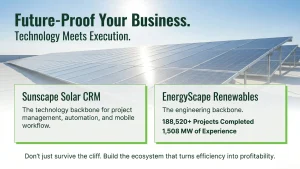
Together, Sunscape CRM and EnergyScape Renewables create an all-in-one solar ecosystem where technology meets execution. While others struggle with disconnected systems and slow turnarounds, you’re moving at the speed your 2026 business demands.
Ready to future-proof your solar business? Connect with Sunscape Solar to discover how the right CRM capabilities can transform your operations, then partner with EnergyScape Renewables to back that technology with world-class engineering services.
The post-tax credit era separates the prepared from the unprepared. Which one will you be?
Book A Demo to experience the sunscape experience, Click Here
Or Contact us: +1 855-263-0700
Frequently Asked Questions About Solar CRM Features 2026
Q: What are the most important solar CRM features for 2026?
A: The seven essential solar CRM features 2026 include automated lead management, project management capabilities, document management systems, integration capabilities, data analytics, mobile access, and workflow automation.
Q: How does the end of the federal tax credit affect CRM needs?
A: Without the 30% ITC cushion, installers cannot afford project delays, lead follow-up mistakes, or manual processes. Solar CRM features 2026 must automate efficiency and maximize every lead.
Q: Can generic CRMs work for solar installers in 2026?
A: While possible, generic CRMs require expensive customization. Solar-specific platforms understand industry workflows immediately, providing faster implementation and better ROI.
Q: What integration capabilities matter most?
A: Critical integrations include engineering partners, financing platforms, accounting systems, communication tools, and design software creating seamless workflows from lead to installation.
Q: How much time does automation save?
A: Industry studies show comprehensive automation saves 10-15 hours per week per salesperson. For a 10-person sales team, that equals the productivity of 2.5 to 3.75 full-time employees.
sjayakanth@energyscaperenewables.com