
End-to-End Solar Project Management in 2026: CRM + Engineering Integration

The Hidden Cost of Disconnected Solar Operations
Every solar installer knows the frustration. Indeed, you’re juggling spreadsheets for lead tracking while simultaneously switching between platforms for design approvals. Meanwhile, you’re chasing down permit statuses through email chains and manually updating clients on project timelines. At the same time, your engineering team works in their own system, completely disconnected from your sales pipeline. Consequently, this fragmentation doesn’t just waste time—it costs you money, delays projects, and damages your reputation with customers who expect seamless communication.
The solution? An integrated solar CRM engineering integration that bridges the gap between your sales operations and technical workflows. As we head into 2026, the most successful solar installers and EPCs are abandoning disconnected tools. Instead, they’re embracing unified platforms that manage everything from initial lead contact through final PTO (Permission to Operate).
Why Solar Installers Are Ditching Disconnected Systems
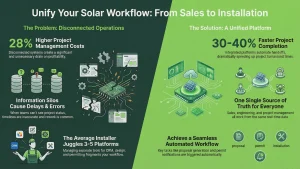
Traditionally, managing solar projects involves three to five different software platforms. For example, you might use one tool for CRM, another for design, and a third for permitting. Additionally, spreadsheets handle everything else. As a result, this creates information silos that slow down your entire operation.

When your sales team can’t see what’s happening in engineering, they consequently can’t give customers accurate timelines. Similarly, when engineers lack visibility into contract details, they waste time on unnecessary revisions. Furthermore, project managers without centralized dashboards struggle to identify bottlenecks before they become costly delays.
According to recent industry data, solar companies using disconnected systems report 28% higher project management costs. In fact, that’s a significant drain on profitability, particularly for residential installers working on tight margins.
The Power of Solar CRM Engineering Integration
Solar CRM engineering integration changes everything. Instead of information living in isolated systems, your entire team works from a single source of truth. Moreover, here’s what that looks like in practice:
Seamless Data Flow from Sales to Installation
When your sales rep closes a deal, that information automatically flows to your engineering team. Therefore, no manual handoffs occur, no details go missing, and no delays happen. The engineering department receives all customer requirements instantly. Subsequently, they can start system design work without waiting for someone to forward emails or dig through shared drives.
Real-Time Project Visibility for Every Stakeholder
With integrated systems, everyone sees the same information simultaneously. Specifically, your sales team knows exactly where each project stands in the engineering queue. Meanwhile, project managers can track multiple installations on visual dashboards. At the same time, customers receive automated updates when their project hits key milestones like design completion or permit approval.
Automated Workflow Management
Modern integrated platforms automate the tedious coordination work. For instance, when engineering completes a system design, the platform automatically notifies your permitting team. Then, it generates the necessary documentation. Once permits are approved, installation crews receive automatic scheduling notifications with all relevant project details.
Essential Features for Complete Solar CRM Engineering Integration
Not all platforms offer true solar CRM engineering integration. Therefore, here’s what to look for when evaluating systems:

Unified Customer Database
First and foremost, your CRM should maintain complete customer records including sales interactions, engineering notes, and installation details. Consequently, this eliminates duplicate data entry and ensures nobody misses critical information. Additionally, having all customer data in one place makes it easy to identify upsell opportunities.
Integrated Design and Engineering Tools
The best platforms either include native design capabilities or integrate seamlessly with popular solar design software. Furthermore, design files, energy production estimates, and equipment specifications should automatically link to customer records. As a result, engineers can work efficiently without switching between systems.
Smart Proposal Generation
Once engineering finalizes a design, your system should automatically generate professional proposals. In addition, these proposals should include accurate pricing and system specifications. Consequently, this dramatically reduces the time between design completion and contract signing.
Permitting and Compliance Tracking
Integrated systems track permit applications, AHJ requirements, and utility interconnection requests in one location. Moreover, smart platforms send automatic reminders when permits need follow-up. Therefore, inspections never catch your team off guard.
Financial Management
For EPCs managing commercial projects, integrated financial tracking is essential. Specifically, your platform should handle progress billing, change orders, and material procurement. Moreover, all this should link to the same project records your teams use daily.
How Integration Improves Project Efficiency
When you eliminate information silos through solar CRM engineering integration, several efficiency gains emerge. In fact, the improvements are immediate:
Faster Project Turnaround: Companies using integrated platforms report 30-40% faster completion times. Specifically, this happens because information flows automatically rather than waiting for manual handoffs.
Fewer Errors and Rework: When everyone works from the same data, miscommunication drops dramatically. As a result, engineers don’t design systems based on outdated information.
Better Resource Allocation: Project managers gain clear visibility into team workload. Consequently, this makes resource balancing and capacity planning easier. Furthermore, it enables informed hiring decisions.
Improved Customer Experience: Customers notice when your operation runs smoothly. Indeed, they appreciate proactive communication and accurate timelines. As a result, this leads to better reviews and higher retention.
Overcoming Implementation Challenges
Transitioning to integrated systems requires upfront effort. However, the most successful implementations follow these principles:

Start with Leadership Buy-In
First, your engineering manager and sales director need to champion the change. Therefore, involve key stakeholders early in the platform selection process. Moreover, ensure they understand the long-term benefits.
Plan for Training
Next, budget time for thorough team training. Additionally, consider designating “power users” who can help colleagues. Subsequently, these champions will accelerate adoption across your organization.
Migrate Data Thoughtfully
Begin with active projects and current leads. Then, backfill historical data only as needed. In other words, don’t try migrating years of history at once.
Measure Results
Finally, track key metrics before and after implementation. Specifically, monitor project completion times and customer satisfaction scores. Consequently, these numbers will prove ROI and help you fine-tune processes.
Looking Ahead to 2026 and Beyond
The solar industry continues evolving rapidly. As we move through 2026, expect these trends in solar CRM engineering integration:
AI-Powered Forecasting: Platforms will use machine learning to predict timelines and identify delays before they happen.
Enhanced Mobile Capabilities: Field teams will gain robust mobile functionality for real-time updates and documentation from job sites.
Deeper Financial Integration: Expect tighter connections between project management and accounting software for seamless financial tracking.
Expanded Automation: Routine tasks like permit applications and customer updates will become increasingly automated.
Transform Your Solar Business with Integrated Solutions
The gap between sales and engineering doesn’t have to be a constant source of friction. Indeed, with the right solar CRM engineering integration platform, you can create a unified workflow that serves your team and delights your customers.
At EnergyScape Renewables, we understand the challenges solar installers and EPCs face with complex projects. Moreover, our engineering services integrate seamlessly with modern platforms. Specifically, we ensure your designs, permits, and technical documentation flow smoothly. Whether you need PE stamping, permit-ready plan sets, or comprehensive engineering support, we’re equipped to work within your existing systems.
For solar installers looking to elevate operations, consider exploring comprehensive solutions like Sunscape Solar. In fact, these platforms bring together CRM, project tracking, and team coordination in one powerful system.
The future of solar project management isn’t about having more tools. Instead, it’s about having the right tools working together seamlessly. As competition intensifies and customer expectations rise, integrated systems aren’t just nice to have anymore. Indeed, they’re essential for building a scalable, efficient solar business that can thrive in 2026 and beyond.
sjayakanth@energyscaperenewables.com