
Solar Decommissioning: New Regulations Installers Should Know in 2025

Solar Decommissioning Regulations: What US Installers Must Know in 2025
The solar industry faces a mounting challenge as thousands of installations approach end-of-life. Indeed, with 20 states now enforcing statewide solar decommissioning regulations and critical compliance deadlines arriving in 2025, solar installers and EPCs must understand these requirements to avoid costly penalties. Fortunately, proper solar waste management planning ensures regulatory compliance while unlocking recycling opportunities worth billions of dollars.
Understanding Solar Decommissioning Regulations
Solar panel installations typically last 25-30 years before requiring decommissioning. As a result, the first wave of large-scale solar projects is now reaching retirement age. Consequently, state regulators are implementing comprehensive solar waste management rules to protect landowners and the environment.

According to the NC Clean Energy Technology Center’s 2024 snapshot report, 20 states have established statewide solar decommissioning policies. Furthermore, 11 additional states are operating under hybrid state-local frameworks. This regulatory expansion reflects growing concerns about proper end-of-life solar management as more projects near operational sunset. Moreover, this trend shows no signs of slowing down.
Critical Solar Decommissioning Deadlines
Several states have established firm deadlines that solar installers and EPCs must meet. Specifically, North Carolina leads with the most immediate requirements. In fact, all utility-scale solar project owners must register with the Department of Environmental Quality by November 1, 2025. Additionally, projects generating two megawatts or more must submit detailed decommissioning plans and establish financial assurance by this date.
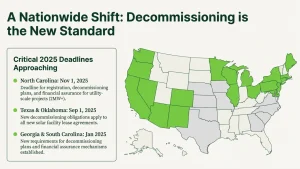
Similarly, Georgia implemented mandatory solar decommissioning requirements in January 2025 for companies leasing property for solar farms exceeding 13 acres. Meanwhile, South Carolina followed with comparable regulations requiring both decommissioning plans and financial assurance mechanisms.
Furthermore, Texas and Oklahoma recently passed legislation establishing decommissioning obligations for solar facility leases. These requirements took effect September 1, 2025, and apply to all new lease agreements. Therefore, installers working in these states must ensure lease documents comply with new standards.
Financial Assurance for Solar Projects
Financial assurance represents one of the most significant regulatory changes affecting solar installers. In particular, states now mandate that project owners demonstrate sufficient funds to complete decommissioning and site restoration.
Acceptable forms include parent company guarantees with investment-grade credit ratings, letters of credit, surety bonds, cash deposits, trust funds, or certificates of deposit. Importantly, the required amount must cover equipment removal, recycling costs, and site restoration, minus salvage value.
For instance, a standard two-megawatt installation faces solar decommissioning costs typically ranging from $60,000 to $150,000. However, these figures fluctuate based on project size, location, and equipment type. Moreover, most states require periodic updates—Texas and Oklahoma mandate updates every five years.
Solar Decommissioning Plan Requirements
State regulations specify detailed requirements for decommissioning plans. In most cases, states require plans prepared and signed by licensed engineers. These plans must outline how solar decommissioning will be conducted, including sequencing, equipment removal procedures, and waste disposal methods.
Furthermore, your plan should identify all equipment to be salvaged with estimated salvage values. This component significantly affects financial assurance calculations since salvage value offsets removal costs. In addition, plans must describe site restoration procedures, including foundation removal, soil decompaction, erosion control, and revegetation strategies.
For example, Rhode Island requires developers to submit decommissioning plans when applying for municipal permits. Subsequently, these plans must detail physical removal of all components including solar panels, anchoring systems, foundations, structures, and electrical equipment. Additionally, municipalities may require performance bonds to cover decommissioning expenses.
Solar Waste Management and Recycling
Beyond decommissioning requirements, states increasingly regulate solar waste handling. Specifically, North Carolina’s regulations define recycling as processing that recovers usable products while explicitly excluding incineration. Moreover, modules classified as hazardous waste must comply with applicable requirements even when recycled.
California pioneered solar-specific recycling regulations requiring reporting by companies handling more than 200 pounds of used panels. Subsequently, starting January 1, 2030, consumers must pay recycling fees. Meanwhile, Washington requires manufacturers selling solar units after July 2017 to finance recycling programs.
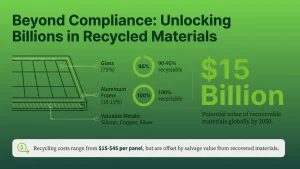
In terms of economics, solar panel recycling costs range from $15 to $45 per panel. Nevertheless, panels contain valuable materials worth recovering. For instance, glass comprises 75% of panel weight (90-95% recyclable), aluminum frames are 100% recyclable, plus recoverable copper, silicon, and silver. Notably, by 2050, recoverable materials could be worth $15 billion globally.
State-Specific Solar Decommissioning Requirements
Understanding state-specific requirements is crucial for solar installers operating across jurisdictions. For example, North Carolina requires registration, decommissioning plans, and financial assurance for utility-scale projects generating two megawatts or more. Specifically, projects must be decommissioned within one year after 12 months without power production.
In contrast, Maine requires developers of projects occupying three or more acres to submit approved plans and financial assurance. Meanwhile, Nevada has established specific recycling requirements. Furthermore, Colorado’s Energy Office must submit a comprehensive evaluation report by September 30, 2025.
Importantly, local governments in many states can establish stricter requirements than state minimums. Therefore, installers must research both state and local solar decommissioning regulations for each project location.
Preparing for Solar Decommissioning Compliance
Proactive planning represents the best strategy for managing solar decommissioning regulations. First and foremost, incorporate decommissioning costs into project financial models from day one, including equipment removal, transportation, recycling, and site restoration.
Additionally, establish relationships with certified recycling facilities early in the project lifecycle. This ensures accurate financial projections and smooth execution when projects reach end-of-life. Furthermore, document all equipment specifications, quantities, and locations throughout installation to simplify future planning.
Equally important, build decommissioning requirements into landowner agreements and lease contracts. Clearly specify responsibilities, timelines, and financial assurance mechanisms to prevent disputes. Finally, stay informed about regulatory developments through industry publications and trade associations.
Business Opportunities in Solar Decommissioning
While new regulations create compliance challenges, they also present significant business opportunities. Indeed, as thousands of installations approach end-of-life, demand for decommissioning expertise will surge dramatically.

Consequently, installers can expand services to include end-of-life management, equipment refurbishment, and recycling coordination. This creates recurring revenue streams while strengthening customer relationships.
For instance, companies like SOLARCYCLE have processed nearly 500,000 panels with partnerships across 90 energy companies. Similarly, SEIA and Solar Panel Recycling launched the first residential panel drop-off program in Mecklenburg County, North Carolina, on January 1, 2025.
Moreover, compliance protects your business from fines, project shutdowns, and license revocations. On the other hand, landowners increasingly demand robust decommissioning provisions in lease agreements. Therefore, compliance expertise provides significant competitive advantages.
How EnergyScape Renewables Supports Solar Decommissioning Compliance
Navigating complex solar decommissioning regulations requires specialized engineering expertise and comprehensive regulatory knowledge. Fortunately, EnergyScape Renewables provides solar engineering services including decommissioning plan development, cost estimation, and financial assurance calculations across all 50 states. Our licensed professional engineers understand state-specific requirements and work directly with solar installers and EPCs to ensure full regulatory compliance.
Whether you’re preparing for upcoming deadlines, expanding into new states, or need expert review of existing plans, our team delivers accurate documentation that protects your projects. Additionally, our platform at Sunscape Solar provides comprehensive project management tools that help track decommissioning obligations throughout the project lifecycle.
Visit EnergyScape Renewables to learn more about our solar engineering services and discover how we help installers stay ahead of evolving decommissioning requirements.
Conclusion: Turning Regulatory Challenges into Strategic Advantages
Solar decommissioning regulations fundamentally reshape how installers approach project planning and lifecycle management. However, companies that embrace these requirements position themselves as industry leaders committed to sustainable, responsible solar development.
Indeed, by understanding state-specific requirements, establishing accurate financial assurance, and developing comprehensive decommissioning plans, solar installers transform regulatory compliance into competitive advantages. Ultimately, this proactive approach drives long-term business success while protecting the environment and strengthening community relationships.
sjayakanth@energyscaperenewables.com