
Choosing Your Solar Business Model: Residential, Commercial, or Both?

Why Your Solar Business Model Choice Matters More Than Ever
Choosing the right solar business model can make or break your success as a solar installer or EPC in today’s competitive market. With residential installations facing a 30% contraction in 2024 and commercial solar emerging as the only growing segment in Q1 2025, the stakes have never been higher. Understanding which business strategy aligns with your resources and expertise can help you navigate these challenges and build a thriving operation.
Understanding Different Market Segments in 2025
The US solar industry is experiencing a significant shift. Installers and EPCs must strategically evaluate their approach to stay competitive. Each market segment presents unique opportunities that directly impact your bottom line.
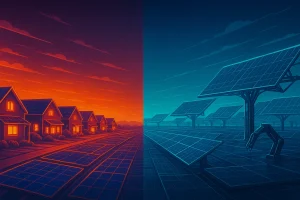
The Residential Solar Installation Approach
Residential solar installations have traditionally been the entry point for many solar installers. This business approach focuses on homeowners looking to reduce electricity bills and increase property value.
Profit margins for residential solar installations typically range from 25-35%, making them attractive for smaller operations. However, these projects require intensive customer education and longer sales cycles. Your residential strategy needs to account for customer acquisition costs ranging from $500 to $1,500 per client.
Additionally, residential solar installers must navigate complex financing options. With the proposed elimination of residential tax credits by the end of 2025, many installers are exploring lease and PPA structures where they retain ownership and claim the commercial Section 48E tax credit instead.
The Commercial Solar Projects Strategy
Commercial solar projects target businesses, nonprofits, and government entities with larger energy needs. In Q1 2025, commercial solar grew by 4%, making it the only solar segment to increase year-over-year.
Commercial solar installations typically yield profit margins between 15-25%. While lower than residential, the project sizes compensate significantly. Furthermore, a single commercial project can generate revenue equivalent to dozens of residential installations.
This business approach requires different expertise, including experience with utility interconnections, complex permitting, and larger-scale engineering. Commercial projects also benefit from Section 48E tax credits remaining intact through 2028.
Community solar represents an emerging opportunity within the commercial sector. This innovative approach allows property owners to lease rooftop space for installations serving multiple subscribers, creating additional revenue streams.
Evaluating Your Resources and Market Position
Choosing between residential and commercial strategies requires honest assessment of your capabilities. Capital requirements differ substantially. Residential solar installations need less upfront investment but require consistent marketing spend.

Meanwhile, commercial solar projects demand higher initial capital for equipment and bonding. However, they offer more predictable revenue streams. Your solar installation business must evaluate working capital and financing relationships before committing to either path.
Technical expertise varies significantly between sectors. Residential installers can operate with smaller crews, while commercial solar projects require specialized engineers and experienced project managers. Therefore, assess your team’s capabilities when selecting your business direction.
The Hybrid Approach: Serving Both Markets
Many successful solar installers are adopting a dual-market strategy serving both residential and commercial clients. This approach offers strategic advantages for your solar installation business.

Diversification protects against market volatility. When residential demand softens, commercial projects stabilize revenue. Conversely, residential installations provide consistent cash flow during commercial slowdowns. This balanced approach helps weather industry fluctuations.
Resource utilization improves with this strategy. Installation crews stay busy year-round alternating between project types. Additionally, equipment investments serve multiple purposes across both residential and commercial solar projects.
However, serving both markets presents challenges. You’ll need diverse expertise spanning residential and commercial sectors, with marketing efforts targeting different audiences.
Financial Considerations for Your Business Strategy
Understanding the complete financial picture helps inform your decision. Residential solar installations deliver faster project turnover but require continuous lead generation investment.

Commercial solar projects involve longer sales cycles but generate larger per-project revenue. Customer acquisition costs for commercial clients range from $2,000 to $5,000, substantially higher than residential. Nevertheless, the average commercial project size justifies this investment.
Hidden costs impact both markets differently. Permitting and compliance typically consume 5-10% of project budgets. Marketing expenses can reach 10-20% of revenue, particularly for residential-focused companies relying on digital advertising.
Cash flow management becomes crucial when establishing your business structure. Residential projects offer quicker payment cycles, while commercial installations require managing larger receivables over extended timelines.
Operational Strategies for Success
Regardless of your chosen path, operational excellence determines profitability. Streamlining installation processes reduces labor costs and improves margins across both residential and commercial solar projects.
Project management software designed for solar installers helps coordinate crews, track materials, and monitor profitability. Investing in these systems early supports scaling your solar installation business efficiently.
Training programs ensure your teams can handle your chosen market’s requirements. Cross-training workers provides flexibility when conditions shift between residential and commercial opportunities.
Adapting to 2025 Market Realities
The solar industry faces unprecedented challenges in 2025. Federal policy uncertainties require flexible business strategies. Commercial-focused companies show greater resilience, with the Section 48E commercial tax credit maintaining support through 2028.

Smart solar installers are positioning themselves to capitalize on emerging opportunities. Community solar projects, battery storage integration, and energy management services complement traditional installation revenue.
Geographic diversification strengthens your competitive position further. While some states experience contractions, others show growth. California’s NEM 2.0 backlog continues supporting commercial installations, while Texas, Florida, and Ohio demonstrate strong distributed solar growth.
Making Your Decision: Key Takeaways
Selecting your solar business model requires balancing multiple factors. Market analysis reveals local opportunities for residential and commercial solar installations. Financial assessment determines which approach aligns with your capital resources.
Starting with one market segment and expanding makes sense for many installers. Begin with residential if you have limited capital and want faster market entry. Alternatively, target commercial solar projects if you possess engineering expertise and stronger financial backing.
Monitor industry trends continuously. Success comes from understanding your strengths, recognizing market opportunities, and positioning your solar installation business accordingly.
How EnergyScape Renewables Supports Your Solar Business Model
Whether you’re pursuing residential, commercial, or a hybrid solar business model, partnering with the right engineering and support services makes all the difference. EnergyScape Renewables provides comprehensive solutions that empower solar installers and EPCs across all market segments.
Our overnight engineering services deliver stamped plans for all 50 states, streamlining your permitting processes regardless of project type. From sales proposals to site surveys, interconnections to CRM solutions, we handle the technical complexities so you can focus on growing your solar installation business. Additionally, our solar project management platform integrates seamlessly with your operations, whether you’re installing residential arrays or managing large-scale commercial solar projects.
The right solar business model combined with expert support positions your company for long-term success in this dynamic industry. Let us help you build the foundation for a profitable, sustainable solar installation business.
sjayakanth@energyscaperenewables.com