
Back to Blog Page
Senate Solar Tax Credits Changes: What Installers Need

Senate Signals Hope for Solar Industry: Key Adjustments Coming to Rooftop Solar Tax Credits
Key Highlights From The Article:
- Senate Adjustments Coming: Senator Kevin Cramer confirms the Senate is working on rooftop solar language adjustments, potentially more generous than the House version
- Market Response: Solar stocks jumped immediately – Sunrun up 15%, Enphase up 11% following the announcement
- Current Threat Level: Both House and Senate versions still eliminate the 30% residential tax credit and solar leasing subsidies
- Timeline Pressure: Projects must begin construction within 60 days of bill passage and complete by 2028 to remain eligible
- Cost Impact: Rooftop systems will cost $8,000-$9,000 more without federal incentives, affecting customer affordability
- Storage Hit Hard: Standalone energy storage ITC completely eliminated for projects starting after December 31, 2024
- Small Installer Risk: Expect 40% reduction in residential solar installations over next five years according to Wood Mackenzie
- Supply Chain Rules: Stricter restrictions on Chinese equipment but some publicly traded companies face fewer limitations
- Job Impact: Over 100,000 solar jobs at risk, with rooftop solar accounting for one-third of industry employment
- Strategic Focus: Installers must diversify revenue streams, optimize operations, and prepare for post-incentive business models
New Senate Solar Tax Credits updates: The solar industry just caught a much-needed break. After months of uncertainty and plummeting stock prices, Senator Kevin Cramer revealed on Tuesday that “there is work being done” on rooftop solar as part of discussions around fixing the language on the future of tax credits for clean energy projects. This development offers a glimmer of hope for thousands of US solar installers and EPCs who’ve been grappling with the potential elimination of critical tax incentives.
What’s Actually Happening in the Senate
The current legislative landscape has been nothing short of a rollercoaster for our industry. The Senate Finance Committee’s draft bill still proposes a full phase-out of solar and wind energy tax credits by 2028, but the tone is shifting. Senator Cramer’s comments suggest that whatever the Senate comes up with, “it might be actually a little more generous than the House” version of the bill.

The market responded immediately to this news. Shares of top residential installer Sunrun closed up 15% at $7.20, while shares of microinverter maker Enphase rose 11% to $38.38 following Cramer’s announcement. This reaction underscores just how critical these adjustments are for industry confidence.
The Current State of Solar Tax Credits Under Threat
Let’s be clear about what we’re facing. Both the House and Senate versions of the Republican budget bill have targeted solar incentives aggressively. The Senate bill eliminates consumer-facing credits for installing rooftop panels and making other energy-related home improvements. This isn’t just about reducing incentives – it’s about completely eliminating them.
The residential solar market has been particularly vulnerable. More than half of residential installations qualify for the 25D tax credit, and rooftop systems will be about $8,000 or $9,000 more expensive without it. For many installers, this price increase could make their services unaffordable for average homeowners.
The leasing market faces an even more immediate threat. A last-minute tweak to the Republican budget bill would immediately end subsidies for solar leasing companies that help make rooftop systems affordable to homeowners. Since about 44% of residential systems sold today are under such arrangements, this change could devastate a significant portion of the market.
Timeline Pressures and Construction Requirements
One of the most challenging aspects of the proposed legislation involves accelerated timelines. The changes would advance by three years an end-date for the use of clean electricity tax credits for wind, solar and battery storage projects to 2028 and require projects to begin construction within 60 days of the bill’s passage.
This 60-day construction requirement is particularly problematic for EPCs managing larger projects. The compressed timeline doesn’t account for permitting delays, supply chain challenges, or the complex coordination required for commercial and utility-scale installations.
Chinese Supply Chain Restrictions: A Double-Edged Sword
The budget bills also strengthen restrictions against Chinese involvement in solar projects. The Senate bill retains some of the restrictions called for in the House bill against the use of tax credits for projects that rely on equipment or critical minerals from foreign adversary nations like China.
However, there’s a silver lining for some companies. Under the Senate solar tax credits bill, some publicly traded companies using materials from China would face fewer restrictions. The bill also introduces a more nuanced approach by creating a formula for calculating whether a project received “material assistance” from a foreign entity that would preclude it from being eligible for the incentive.
For installers, this means you’ll need to carefully document your supply chain and ensure compliance with these foreign entity restrictions to maintain eligibility for any remaining incentives.
Impact on Small Installers vs. Large Players
The proposed changes don’t affect all market segments equally. The subsidy has been critical for small installers whose customers pay cash or take out loans and then claim the credit on their tax returns. Small installers are feeling the pinch most acutely, with some already planning significant layoffs.
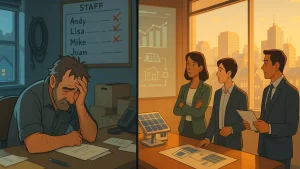
Jack Ramsey, CEO of Altsys Solar in California, represents the challenges facing smaller operations. Ramsey anticipates cutting his nine-person staff to four or five people if the credit is eliminated. This scenario is playing out across the country as small installers prepare for the worst.
Larger companies with third-party ownership models have slightly more breathing room. For panels that are owned by a third party, such as a bank, and leased to homeowners, system owners are able to claim a separate tax credit that the House bill would leave in place until 2032 but start to phase out in 2029.
Economic and Job Impact Projections
The numbers paint a stark picture of what’s at stake. The changes could result in as much as 40% less residential solar capacity being installed over the next five years, according to energy research firm Wood Mackenzie. This reduction would have cascading effects throughout the supply chain.
The job impact extends beyond installers. Rooftop solar accounts for more than a third of solar industry jobs, and the industry now employs more than 100,000 workers. These jobs are distributed across the country, with many of the biggest residential solar markets in states that voted for President Donald Trump, including Texas, Florida and Arizona.
Storage Systems Face Immediate Elimination
Energy storage installers face an even more immediate threat. The draft bill also revokes the investment tax credit for standalone energy storage systems, which was made available under Section 48 following the Inflation Reduction Act. The repeal applies to all projects that begin construction after December 31, 2024.
This means that starting in 2025, no new standalone energy storage projects qualify for the ITC. For EPCs involved in storage installations, this represents an immediate business model disruption that requires urgent strategic planning.
Strategic Recommendations for Solar Installers and EPCs
Given this uncertain landscape, here’s how to position your business:
Diversify Your Revenue Streams: Don’t rely solely on residential installations. Explore commercial projects, maintenance contracts, and energy efficiency services that may be less affected by tax credit changes.
Build Strong Customer Relationships: Focus on value propositions beyond tax credits. Emphasize long-term savings, energy independence, and environmental benefits that remain compelling even without incentives.
Optimize Your Operations: Streamline processes to reduce costs and maintain competitive pricing even if customer incentives disappear. This might mean investing in better project management software or training programs.
Monitor Legislative Developments: Stay informed about Senate negotiations and be prepared to act quickly if favorable adjustments are made to the timeline or incentive structure.
Consider Geographic Focus: Some states offer additional incentives that could help offset federal reductions. Research and potentially pivot to markets with stronger state-level support.
Looking Ahead: What the Senate Solar Tax Credits Adjustments Might Bring
Senator Cramer’s mention of working on the “off ramp” for phasing out tax credits suggests the Senate recognizes the House version’s approach was too abrupt. Cramer said senators are working on adjusting the “off ramp” for phasing out the tax credits, which were abrupt in the House-passed version.
Industry groups have been actively lobbying for changes, arguing that the bill, as written, is a threat to billions of dollars in investment, would increase power prices for consumers and kill jobs in fast-growing industries.
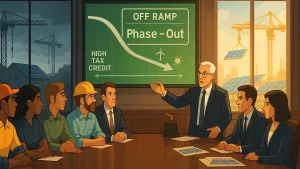
The Senate’s willingness to consider adjustments represents a crucial opportunity for the industry. While we shouldn’t expect a complete reversal of the proposed cuts, more gradual phase-outs and reasonable construction timelines could make the difference between industry survival and collapse.
Senate Solar Tax Credits: Stay Resilient, Stay Ready—with Energyscape Renewables
As federal tax credit changes loom, solar EPCs and installers must rethink how they operate. Success now depends on speed, strategy, and precise execution—especially when timelines shrink and incentives shift.
That’s where Energyscape Renewables makes the difference. We help you move fast and build smart with expert solar engineering, compliant plan sets, and permitting support that’s ready for a tighter, more competitive market.
Our digital suite—Sunscape CRM and the Sunscape Site Survey App—streamlines data capture, team coordination, and proposal workflows. So even as policy changes disrupt the market, your operations stay smooth, scalable, and ahead of schedule.
Uncertainty is here—but so is opportunity. Energyscape Renewables gives you the tools to adapt and grow.
Tag:

1 Comment
[…] Want To Know the backstory to this tax credit issue, Read This […]