
Solar AI Technology: Top AI Trends In 2025

How Solar AI Technology is Transforming US Installations in 2025: The Smart Revolution Every EPC and Installer Must Know.
The solar industry in America is experiencing its biggest transformation yet, and it’s not just about adding more panels to rooftops. The US solar industry installed 10.8 gigawatts direct current (GWdc) of capacity in Q1 2025, a 7% decline from Q1 2024 and a 43% decrease compared with Q4 2024 but still the fourth largest quarter on record. Solar accounted for 69% of all new electricity-generating capacity added to the US grid, proving that despite quarterly fluctuations, solar remains the dominant force in America’s energy expansion.
But here’s what’s really changing the game: artificial intelligence is completely reshaping how US solar installers and EPCs operate, design, and maintain solar systems. This isn’t some distant future scenario – it’s happening right now in communities across America, from California’s sprawling solar farms to Texas rooftops.
Why 2025 Marks the Solar AI Turning Point
The global solar AI market size was estimated at USD 5.96 billion in 2024 and is projected to grow at a CAGR of 20.8% from 2025 to 2030, reflecting unprecedented investment in smart solar solutions. Meanwhile, energy demand was up 2% in 2024 and is expected to continue to grow at 2% in 2025 and 2026, driven largely by data centers and AI applications creating massive electricity demand.
This perfect storm of growing energy needs and advancing AI technology creates extraordinary opportunities for solar professionals who embrace smart solutions. Companies that integrate AI tools today position themselves ahead of competitors still using traditional approaches.
Smart Forecasting: Predicting Solar Performance Like Never Before
Traditional weather forecasting often misses the nuanced patterns that affect solar energy production. Smart AI systems analyze multiple data streams simultaneously – historical production data, real-time weather conditions, satellite imagery, and local micro-climate patterns – to deliver incredibly accurate predictions.
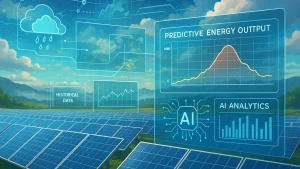
Revolutionary Weather Analysis
AI forecasting systems can identify specific cloud formations that will reduce solar output by 20% within the next hour. This level of precision allows grid operators to adjust energy storage reserves proactively, while giving solar installers the data they need to provide accurate performance guarantees to customers.
These systems continuously learn and improve. They recognize patterns in how different neighborhoods consume solar energy throughout the day, enabling installers to design systems that match actual usage patterns rather than relying on generic calculations.
Real-World Impact for Installers
For solar EPCs managing multiple projects, enhanced forecasting capability translates directly to improved project success rates and customer satisfaction. When you can predict system performance with 95% accuracy instead of 75%, you gain a significant competitive advantage in proposal development and customer retention.
Automated Installation: Streamlining Every Step of Solar Deployment
The manual processes that have traditionally slowed down solar installations are giving way to AI-powered automation that’s transforming project management and execution.
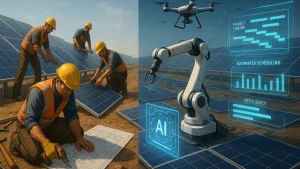
AI-Driven Project Management Systems
Field service management platforms enhanced with AI are enabling solar EPCs to scale dramatically without proportional increases in staff. Companies report scaling from 20 to 120 projects monthly without increasing headcount, thanks to intelligent scheduling and resource optimization.
These platforms optimize technician workloads automatically, reduce project cycle times through smart routing, and ensure compliance with safety regulations through automated checklists and monitoring. The result is faster project completion and improved profitability across all installation types.
Smart Design and Engineering Tools
AI assists in creating precise 3D models and simulations that optimize panel placement for maximum energy production. These tools consider geographical factors, environmental conditions, shading patterns, and even local building codes to design systems that deliver optimal performance.
For solar EPCs working on complex commercial or utility-scale projects, AI-powered design tools significantly reduce engineering time while improving system efficiency. This technology proves particularly valuable in challenging installation environments where manual design processes would be time-intensive and error-prone.
Intelligent Energy Storage Integration: Beyond Basic Battery Systems
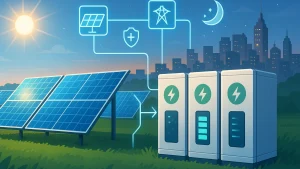
Energy storage continues gaining importance as solar installations become more sophisticated. The integration of energy storage systems is addressing the intermittency of solar power, improving grid stability, and enabling energy availability during peak demand or nighttime.
Advanced Battery Management
AI-powered battery management systems optimize charging and discharging cycles based on energy demand patterns, weather forecasts, and grid conditions. These smart systems learn from usage patterns to maximize battery life while ensuring power availability during peak demand periods.
For solar installers, this technology enables comprehensive energy solutions that go beyond simple panel installation, creating additional revenue opportunities and deeper customer relationships.
Grid Integration Excellence
Smart inverters use AI algorithms to manage power flow, maintain grid stability, and optimize energy distribution in real-time. This capability becomes increasingly important as more distributed solar systems connect to the grid, requiring sophisticated management to prevent overload and ensure reliable operation.
Predictive Maintenance: Maximizing Long-Term System Performance
Traditional maintenance approaches wait for problems to occur before addressing them. AI-powered predictive maintenance takes a proactive approach that prevents issues before they impact system performance.
Drone-Based Inspection Revolution
AI-powered drone inspections are transforming solar system maintenance. Deep learning algorithms analyze drone-captured images to detect dust buildup, panel misalignment, surface damage, and other issues that affect performance with remarkable accuracy.
This technology enables solar installers to offer proactive maintenance services, identifying problems before they cause significant energy losses. The result is improved customer satisfaction and additional revenue opportunities for service-oriented solar companies.
Equipment Health Monitoring
Machine learning models continuously monitor solar panels, inverters, and other system components to predict potential failures. This predictive maintenance approach reduces unexpected downtime and extends equipment life significantly.
For solar EPCs, offering AI-powered monitoring services creates ongoing customer relationships beyond the initial installation, generating recurring revenue while ensuring optimal system performance throughout the system’s lifetime.
Data Analytics: Turning Information into Competitive Advantage
AI excels at recognizing complex patterns in large datasets that would be impossible for humans to identify manually. Solar energy providers use deep learning algorithms to analyze historical production data, weather conditions, and energy consumption trends to identify optimization opportunities.
Performance Pattern Recognition
These insights help solar installers design better systems and provide more accurate performance estimates to customers. Additionally, data analytics reveal market trends that inform business strategy and growth planning, giving forward-thinking companies crucial competitive intelligence.
Customer Behavior Analysis
AI systems analyze how different customer segments use solar energy, enabling installers to develop targeted marketing strategies and customized system designs. This personalization improves customer satisfaction and increases sales conversion rates significantly.
Regulatory Compliance and Safety Enhancement
Automated Compliance Tracking
AI platforms help solar EPCs maintain compliance with evolving safety and regulatory requirements through automated tracking and reporting systems. These tools ensure installations meet local codes and industry standards while reducing administrative overhead.
Safety Risk Assessment
Machine learning algorithms analyze installation sites to identify potential safety hazards and recommend appropriate mitigation strategies. This proactive approach reduces workplace accidents and insurance costs for solar installation companies.
Corporate Investment Driving Solar Demand
Major technology companies are creating massive demand for solar solutions through unprecedented renewable energy investments. With companies like Microsoft announcing billion-dollar investments in data centers in 2025, this industry alone is responsible for an exponential increase in energy demand in the coming decade.
Amazon maintains extensive solar project portfolios, while Google has invested billions in energy infrastructure combining data centers with clean energy generation. Microsoft contracted substantial capacity from multiple solar installations just in early 2025, adding to their existing gigawatt solar portfolio.
These investments demonstrate the growing corporate demand that creates substantial opportunities for solar installers and EPCs nationwide.
Implementation Strategies for Solar Professionals
Start Small, Scale Smart
Solar installers should begin AI adoption with focused applications like project management or performance monitoring before expanding to more complex systems. This approach allows teams to gain experience while demonstrating clear value to stakeholders.
Partner Selection Criteria
Choose AI technology partners with proven experience in the solar industry. Look for platforms that integrate easily with existing workflows and provide comprehensive training and support. Avoid vendors without demonstrated success in solar applications.
Data Quality Investment
AI systems require high-quality data to deliver accurate results. Invest in proper data collection and management processes to maximize the benefits of AI implementation. Clean, consistent data is the foundation of successful AI deployment.
The Future is Now: Embracing Solar AI Technology
The convergence of artificial intelligence and solar technology represents more than just an industry trend – it’s the foundation of tomorrow’s energy infrastructure. Companies that embrace AI-powered solutions now will be better positioned to reduce operational costs, improve efficiency, and gain a competitive edge in the rapidly evolving renewable energy market.
Solar continues to prove itself as an inexpensive energy source that can be deployed anywhere in the U.S., making its presence in our future energy mix undeniable. When combined with AI technology, solar becomes not just affordable and scalable, but intelligent and optimized for maximum performance.
The question isn’t whether AI will transform the solar industry – it’s already happening. The question is whether your company will lead this transformation or struggle to catch up. The solar professionals who invest in AI technology today are building the sustainable energy infrastructure that will power America’s future.
Ready to harness the power of AI for your solar projects? The time to act is now, while the competitive advantages are still available to early adopters.
AI is Evolving Solar: Energyscape Renewables Helps You Keep Up.
AI is changing how solar gets designed, installed, and maintained—but to unlock its full potential, fast and accurate interconnection is non-negotiable. That’s where Energyscape Renewables delivers.
From AI-ready plan sets and utility-compliant designs to expert interconnection documentation and PE stamping, we help solar EPCs and installers stay ahead of technical and regulatory demands.
Pair our engineering expertise with the Sunscape Site Survey App and CRM, and you get the speed, accuracy, and digital edge your projects need in 2025’s AI-powered solar landscape.
Stay smart. Stay connected. Grow with Energyscape Renewables
sjayakanth@energyscaperenewables.com